














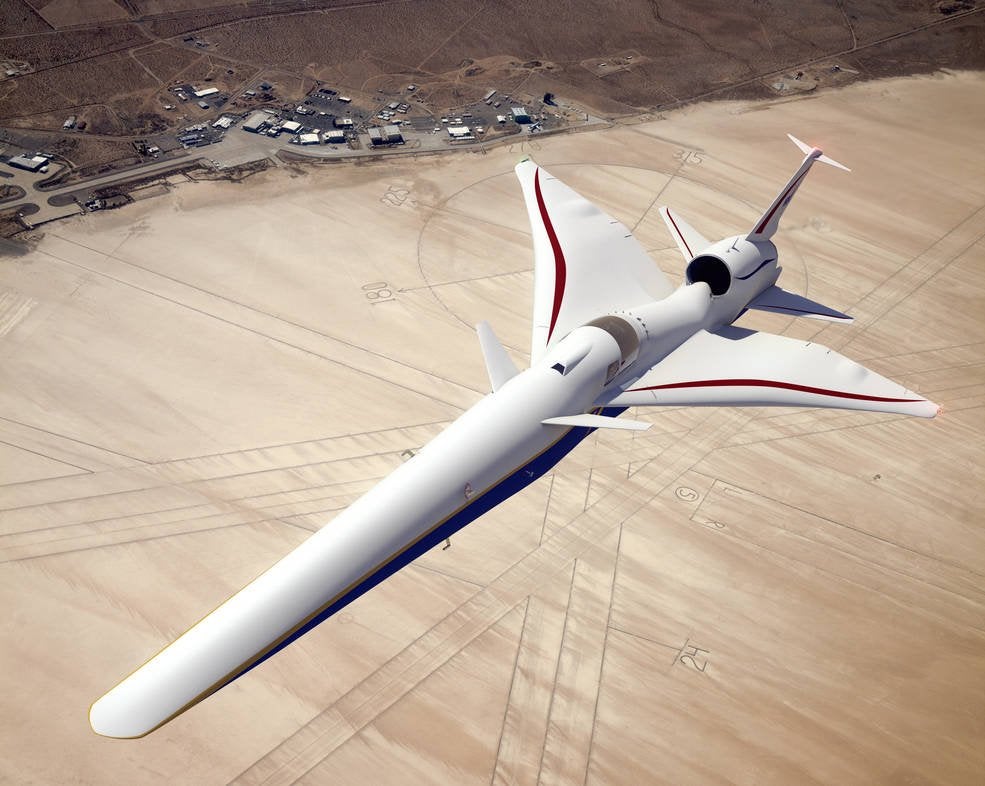

NASA has announced the successful completion of in-flight testing on the eXternal Visibility System (XVS) for its X-59 Quiet SuperSonic Technology (QueSST) aircraft. According to NASA, the XVS “virtual window” forward-facing camera and display system creates “an augmented reality view of the X-59 pilot’s forward line-of-sight along with graphical flight data overlays.” The supersonic X-59 was designed without a forward-facing window to allow the nose to be slimmer and more contoured, producing smaller shockwaves and reducing noise.
“Our goal is to create an electronic means of vision for the X-59 pilot that provides performance and safety levels equivalent to or better than forward-facing windows,” said XVS subsystem lead Randy Bailey. XVS testing took place at NASA’s Langley Research Center in Hampton, Virginia, using a Beechcraft King Air UC-12B. NASA says testing focused on identifying traffic in a variety of scenarios using a “comparison of the time required to recognize the target aircraft by a pilot seated in the cockpit of the UC-12B looking through forward windows and a pilot seated in the cabin of the same UC-12B at the controls of the functional XVS mock-up.”
As previously reported by AVweb, NASA plans to fly the X-59, which is being built by Lockheed Martin, for the first time in 2021. It will be the agency’s first piloted, full-size X-plane in more than 30 years. NASA’s goal with the project is to develop technology that will allow an aircraft capable of traveling at supersonic speeds to remain quiet enough to overfly populated areas.
