
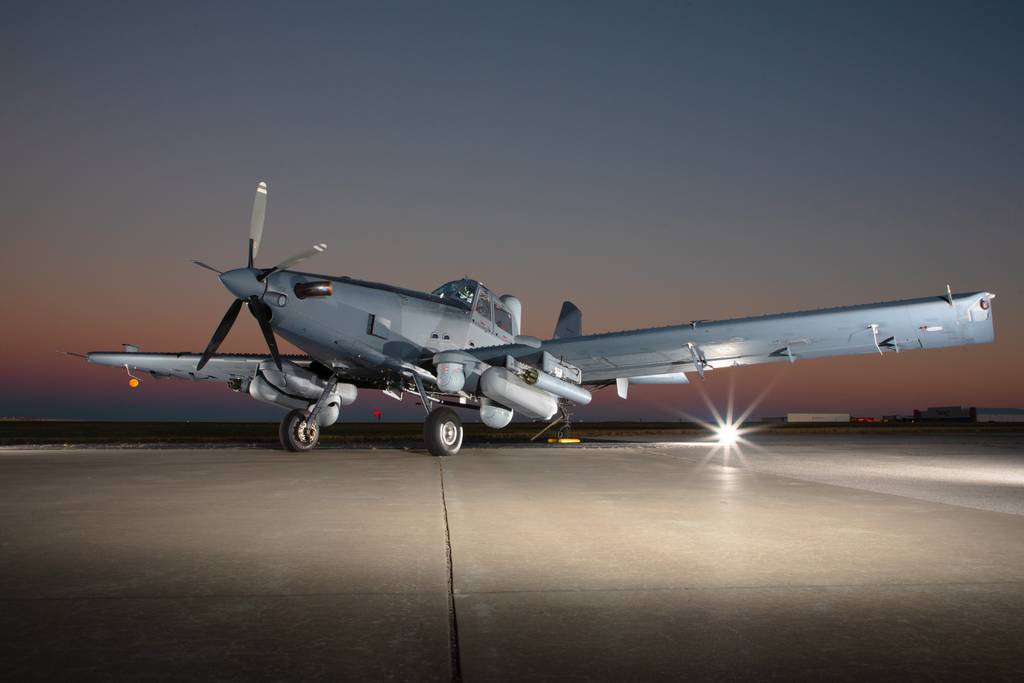

Under a contract worth up to $3 billion, U.S. Air Force Special Operations Command (AFSOC) last August chose the AT-802U Sky Warden, a single-engine turboprop with an interesting difference for a modern military aircraft. The service plans to acquire up to 75 for “counterterror” duty. Derived from the Leland Snow-designed Air Tractor agricultural application aircraft (aka cropduster), the Sky Warden is ruggedly built and designed for low-altitude ops at high gross weights, but also has a landing gear configuration harkening back to World War II.
AFSOC boss Lt. Gen. Jim Slife said, “We’re going to have to pay a lot of attention to training on this. We haven’t operated, at scale, a taildragger aircraft in quite some time.” Of course, most of the fighters from World War II were taildraggers, virtually a necessity to accommodate the large-diameter propellers driven by the high-power piston inline and radial engines of the day. After 1945, virtually all jet fighters were nosewheel-configured. The chapter on the art and wisdom of landing and taking off with a tailwheel was deleted from military training manuals.
L3Harris teamed with Air Tractor to offer the aircraft, which will be newly designated as the OA-1K. Developing a training protocol will be a focal point as the aircraft moves toward deployment.
“What this means is that during taxi, takeoff and landing operations, pilots need to be more cognizant of aircraft alignment and crosswinds,” said AFSOC spokesperson Lt. Col. Becky Heyse. “Tailwheel aircraft are more prone to rotational forces around their center of gravity, due to [their] location in relation to [the] main gear.”