















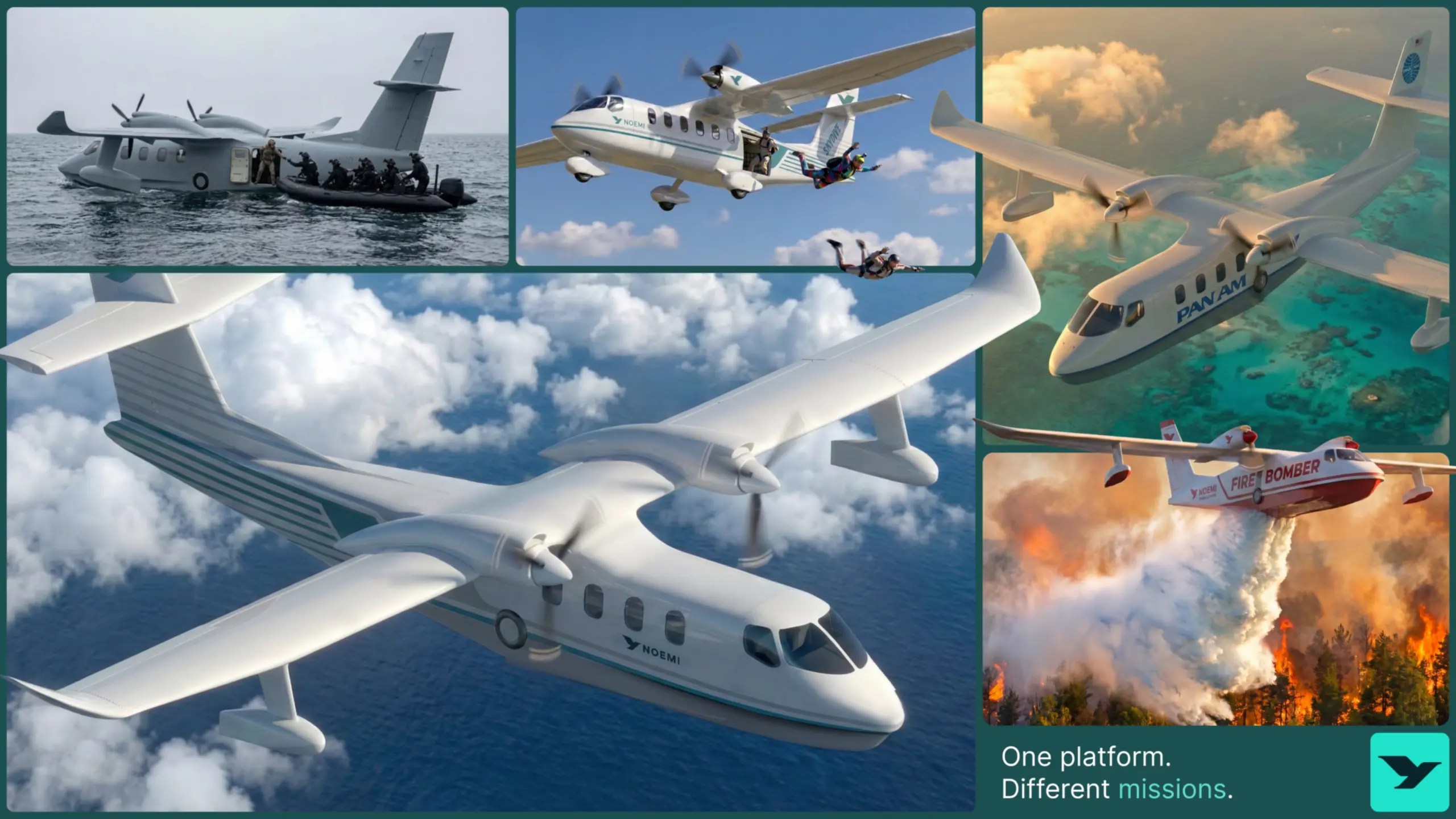

Norway-based NOEMI Aerospace has outlined plans to expand its aircraft development strategy beyond its initial electric amphibious passenger aircraft, including future variants it is evaluating for cargo, government, search-and-rescue, skydiving, aerial firefighting and dual-use military applications.
The company said Wednesday that the broader approach is based on a common aircraft architecture. NOEMI said its fully electric amphibious aircraft remains its primary program for regional passenger transportation, while other configurations could include hybrid-electric or conventional propulsion where mission requirements call for additional range, payload or operating flexibility.
“NOEMI was always designed as more than a single aircraft,” founder and CEO Eric Lithun said. “We are building a platform that can evolve over time and address multiple markets while leveraging shared technology, engineering and certification pathways.”
The company also said it has completed preliminary design review work, is continuing prototype development and propulsion testing, and is progressing under a Pre-Application Contract agreement with EASA. NOEMI is targeting first flight in 2027 and commercial operations by 2030.


Two points. What was flight endurance.of each flight and " refuelling" time between flights. ??.
what useful payload was carried on each flight. ??
Finally, rather than.just repeat their PR release unquestioningly, why not ask.these questions before publication??
Agree! I’m beginning to suspect this page is run by some dude in his basement using cheap AI.
As for this equipment… a flying boat uses an incredible amount of its power to just take off.. water resistance a strengthened hull, and a water bomber an even bigger challenge. Ridiculous.
dotcom Shortout coming, investment market is full of overly optimistic promotions.Often without pockets to carry the project through to commercial success.
Seen with VLJ hype - costs of development and production way underestimated, market way overestimated. Only two went into production:
479 Mustangs produced but sales evaporated in competition with larger M2 version of Citation.
Vern Raeburn badly underestimated weight of his Eclipse 500 concept, which made Williams’ engine unsuitable, Williams was unable/unwilling to increase size of engine nor continue to help with airplane design, so Raeburn decamped to New Mexico.
Raeburn’s duff was saved temporarily by P&WC who had been secretly developing an engine for Cessna’s Mustang. He stumbled through upsets of avionics suppliers and airframe refinements, to produce 61 aircraft. Went broke, someone bought the product cheap and tried to at least support in-service airplanes.
Eclipse did use ‘friction stir welding’ of aluminum, which Boeing had demonsrated.
History, folks - learn from it.
You have to do everything well as you do not get a second chance.
Friction stir welding was probably helpful to costs of production, but is only one thing. When short of money there’s a temptation to cheapen - I ask 'If you can’t afford to do it right the first time how will you afford to fix it?
The VLJ project out of western IA is an example. They built and test flew a prototype, that revealed that changes to aerodynamics were needed. But investors did not step up with more money for that, let alone production. They failed renowned Cable and Howse Ventures’ criteria 3 - ‘Can these people follow through?’.
Whereas Cessna had the reputation and pockets to do the job, just underestimated cost of production.
Successful Seattle area VC company Cable and Howse’s criteria 2 was ‘Can we trust these people?’
Criteria 1 for evaluating projects offered to them was simply 'Are we interested in this field? - they focussed on medical and software.
(My source is a talk by Tom Cable that I attended.)