















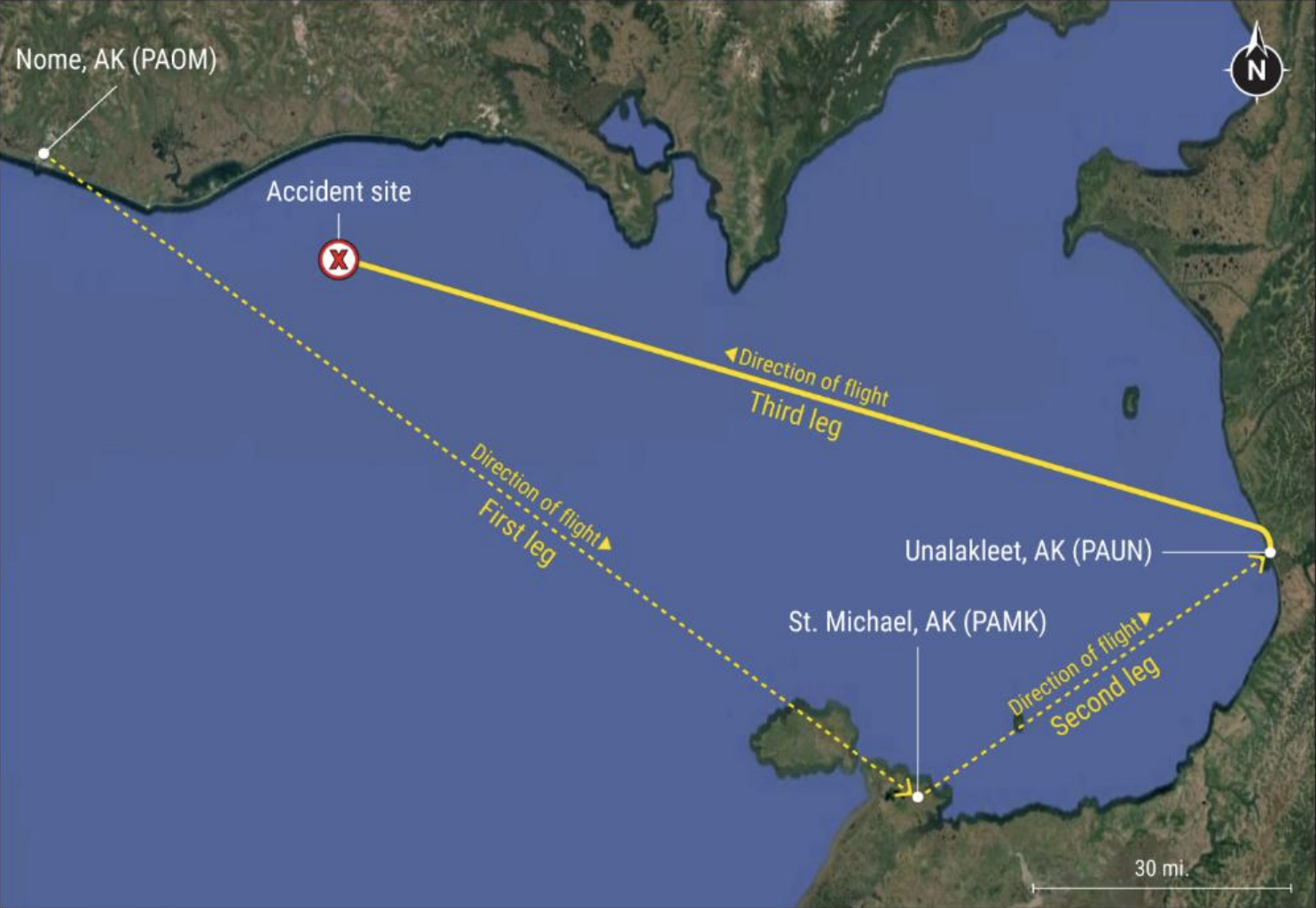

The NTSB said in its final report that inadequate airspeed management and operation above maximum weight led to the February 6, 2025 Bering Air Flight 445 accident near Nome, Alaska. The Cessna 208B Caravan impacted pack ice about 12 miles offshore, killing the pilot along with nine passengers.
Airspeed Decreased During Descent
While descending toward Nome Airport, the Bering Air flight encountered severe icing conditions, including supercooled large droplets. Both runways at the airport were temporarily closed for deicing, so an air traffic controller advised the pilot that he could reduce the aircraft’s speed to help delay arrival.
Engine power reduced and airspeed dropped from about 160 knots to 110 knots, before increasing again up to 126 knots. Airspeed later lowered again to 99 knots. This activated the aircraft’s low-airspeed awareness system and automatically disengaging the autopilot.
Investigators determined that the Bering Air pilot’s workload and degraded situational awareness resulted in inadequate airspeed monitoring. The pilot subsequently made control inputs that increased the airplane’s angle of attack, and the airplane entered an aerodynamic stall and loss of control. The NTSB found that air traffic control handling of the flight complied with applicable procedures and did not contribute to the accident.
Airplane Exceeded Weight Limit
The aircraft took off with a gross weight of about 9,798 pounds, the NTSB estimated, 991 pounds above the maximum gross weight in those conditions. Although the flight report listed 1,000 pounds of fuel, Garmin G1000 data indicated that 1,464 pounds.
Reviews of 35 flight legs showed that seven of those flights had exceeded weight limitations. The NTSB said Bering Air’s flight risk assessment and operational control procedures failed to prevent overweight operations from ocurring regularly.
Investigators also found that FAA oversight did not identify Bering Air’s rapid growth and increased operational complexity as factors warranting additional surveillance.
The airplane’s TKS ice-protection system functioned as designed and prevented significant ice accumulation on protected surfaces.
Recommendations Address Part 135 Operations
“The tragedy of Flight 445 was not the result of a single failure, but a series of preventable breakdowns that eroded critical safety margins,” NTSB Chair Jennifer Homendy said in an agency statement Thursday. “I’ve seen how Alaskan communities use aviation as a lifeline. Once implemented, our recommendations will make that lifeline safer and prevent other communities from experiencing similar heartbreak.”
The NTSB recommended that the FAA require upset prevention and recovery training for most Part 135 and fractional ownership operators. It also recommended explicit surveillance criteria for operators experiencing rapid growth or increased complexity. The agency reiterated previous recommendations concerning certificated dispatchers, flight data monitoring programs, expanded load manifest requirements and crash-resistant flight recorder systems.


Well, At least they had a minute or two to pray on the way down, if they were so inclined.