
The National Transportation Safety Board (NTSB) determined last year’s near collision between a Southwest Airlines Boeing 737 and a FedEx Boeing 767 on an Austin, Texas, runway was caused by a lack of critical safety technology and errors made by an air traffic controller.
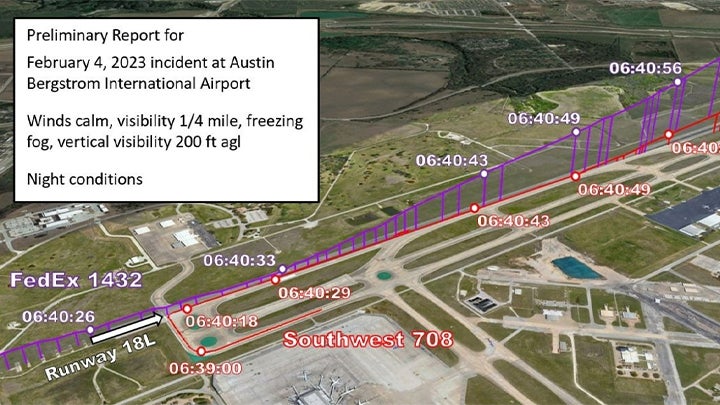
The Feb. 4, 2023, incident was one of several close calls that led to the Federal Aviation Administration (FAA) calling for an industry-wide safety summit. During the near-miss in Austin, the two jets came within 150 feet of colliding after being cleared to use the same runway. The FedEx crew averted disaster by initiating a go-around and overflying the Southwest aircraft after spotting its silhouette as it was rolling down the runway.
The report highlighted poor visibility conditions on the morning of the incident and the air traffic control tower’s lack of surface detection equipment for monitoring traffic on the taxiway and runway.
The NTSB cited the probable cause as the controller’s incorrect assumption that the Southwest Airlines jet would take off from the runway before the FedEx aircraft arrived, leading to a loss of separation between the two aircraft. Expectation bias, lack of situational awareness and the tower controllers’ lack of training on low-visibility operations were listed as contributing factors. Additionally, the NTSB noted that the Southwest flight crew contributed to the incident by not informing the controller that they would need additional time on the runway for an engine runup before takeoff.
“One missed warning, one incorrect response, even one missed opportunity to strengthen safety can lead to tragedy and destroy public confidence in our aviation system, which is precisely why we must learn from near misses such as these,” said NTSB Chair Jennifer Homendy in a June 6 press release. “We are once again calling on the FAA to use technology to prevent runway incursions—something we’ve been doing for decades—because we must back up the humans operating in our aviation system at every level. That is how we save lives.”
The FAA said it would begin installing surface detection systems at some U.S. airports, including Austin, by the end of 2025.
The NTSB said the final incident report will be available in the coming weeks.