














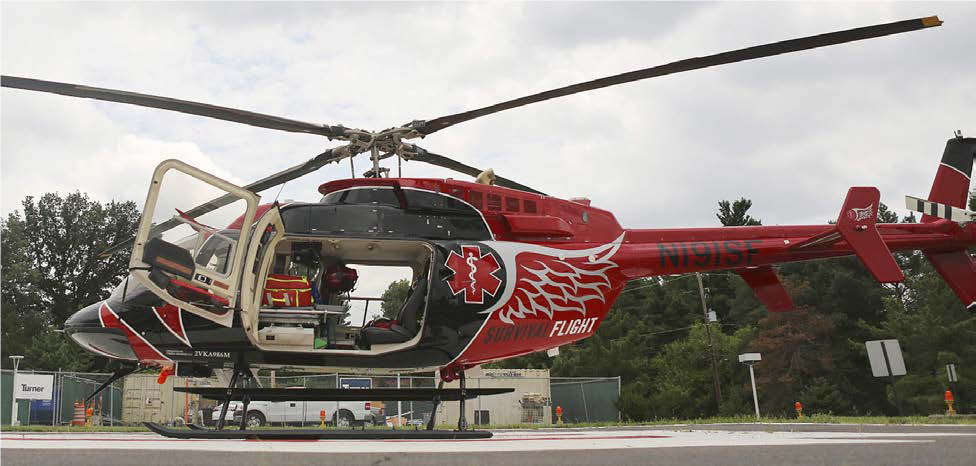

The National Transportation Safety Board (NTSB) announced on Tuesday that the Jan. 29, 2019, crash of a Bell 407 air ambulance helicopter in Zaleski, Ohio, was caused by the operator’s “inadequate management of safety.” The helicopter, which was only certified to operate in visual flight conditions, collided with trees in a heavily wooded area after failing to maintain altitude following inadvertent flight into instrument meteorological conditions. All three crew members onboard were killed.
As previously reported by AVweb, the aircraft was operated by Survival Flight Inc. and was en route to pick up a patient from Holzer Meigs hospital in Pomeroy, Ohio. According to the NTSB, a thorough preflight weather evaluation had not been conducted prior to the accident flight. The board found (PDF) that pilots and operations staff at the company routinely failed to comply with preflight risk assessment procedures, noting that noncompliance with those procedures had become “normalized by Survival Flight’s deficient safety culture.” Company employees also reported in post-accident interviews that they encountered pressure from management “to operate flights in challenging conditions and to take flights that other helicopter air ambulance services turned down due to inclement weather.”
“This accident was all but invited by the actions and culture of Survival Flight,” said NTSB Chairman Robert Sumwalt. “Unfortunately, we have seen yet another case of how a poor safety culture can lead to tragedy.” The NTSB also cited inadequate FAA oversight of Survival Flight’s risk management program and the FAA’s failure to require helicopter air ambulance operators to have safety management systems as contributing factors in the accident.
