














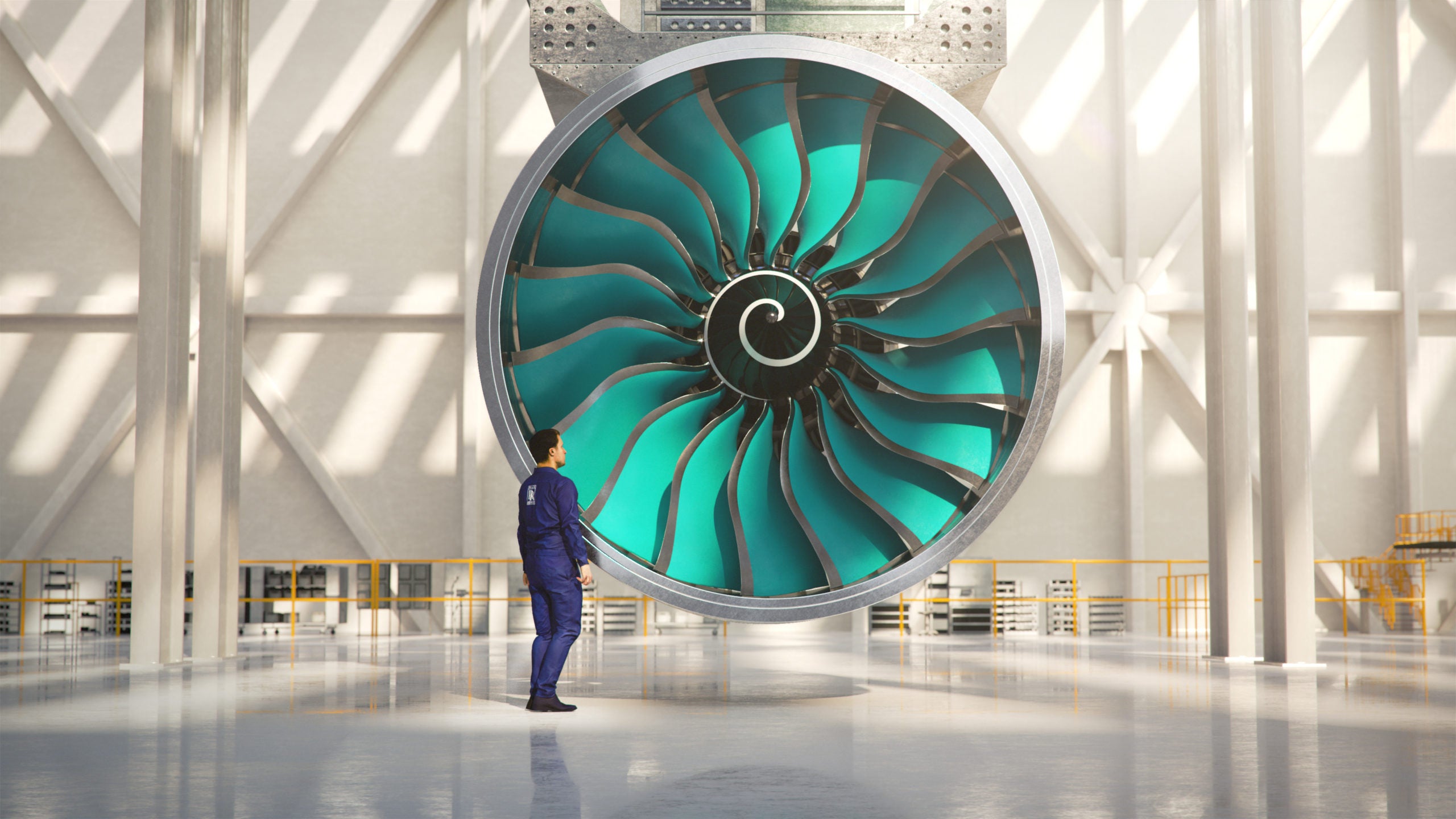

Rolls-Royce announced on Monday that it has officially started building its UltraFan demonstrator engine at the company’s dedicated DemoWorks facility in Derby, U.K. According to Rolls-Royce, the completed UltraFan will be the largest aeronautical engine ever built with a fan diameter of 140 inches. The company says the UltraFan will deliver a 25 percent improvement in fuel efficiency compared to the first-generation Trent engine.
“This is an exciting moment for all of us at Rolls-Royce,” said Chris Cholerton, Rolls-Royce Civil Aerospace president. “Our first engine demonstrator, UF001, is now coming together and I’m really looking forward to seeing it built and ready for test. It is arriving at a time when the world is seeking ever more sustainable ways to travel in a post-COVID-19 world, and it makes me and all our team very proud to know we are part of the solution.”
The UltraFan demonstrator is expected to be the basis of a new engine family designed to power both narrowbody and widebody aircraft. It will feature Rolls-Royce’s Advance 3 core architecture and advanced low emissions combustion system (ALECSys), carbon titanium fan blades and a composite casing, advanced ceramic matrix composite (CMC) components and a geared design. Construction of the UltraFan demonstrator is scheduled to be completed by the end of the year, after which it will be tested at the company’s new £90 million (about $123 million) Testbed 80 facility.
