















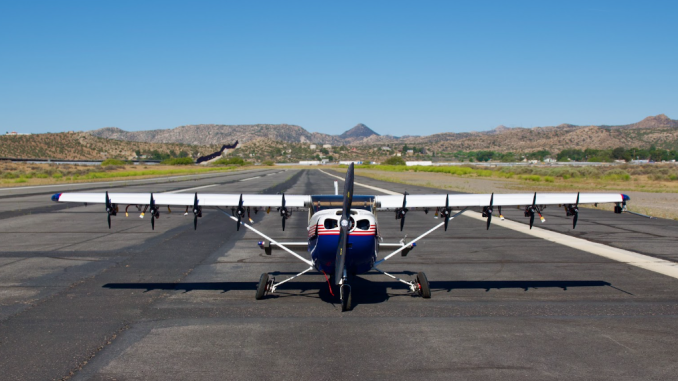

Wayfarer Aircraft has completed flight testing of a retractable distributed electric propulsion system designed to improve short-field performance on existing aircraft. The company tested its Waylift system on a one-third-scale Cessna 182 as part of a NASA-backed research program.
System Stows for Cruise
Waylift places multiple electric propellers along the wing to blow air over the wing during takeoff and landing, increasing lift at low speeds. The propellers retract into the wing for cruise flight. Wayfarer said in a company release that testing produced four times the lift of the unmodified aircraft and required 40% less thrust than typical distributed electric propulsion systems at equivalent lift.
“The question going into Phase II was whether a propulsor you can stow inside the wing could still deliver the high-lift performance of a pylon system. It can, and it does it with substantially less thrust,” Wayfarer CEO Byron Ward said in the release. “We were also able to fly the exact same airframe back-to-back with and without the system, demonstrating how the technology can be retrofitted to upgrade existing aircraft.”
NASA-Backed Testing
Wayfarer worked with Embry-Riddle Aeronautical University on the propulsion and flight-control systems. Embry-Riddle also flew an instrumented full-scale Cessna 182 to compare its aerodynamic behavior with the subscale demonstrator. The NASA project was intended to collect aerodynamic and acoustic data that could be used to evaluate the technology for both new and modified aircraft.
The Phase II research received an approximately $900,000 NASA award. Wayfarer says the company is targeting applications ranging from short-field civil aircraft to military and public-safety operations.


The main gear on the 182 in the photo doesn’t look good with the wheels splayed outward. Adding all those electric motors has got to increase the weight significantly. I read that the motors are powered by on-board batteries since the surge in the power required at takeoff is too much for the aircraft’s electrical system. That’s got to increase weight significantly and limit endurance. I also read that it can take off in 250 feet. The powered lift idea is a good one but battery technology has got to come a lot further to make it viable. eVTOL technology with a hybrid engine seems to be a better strategy.
I cannot believe that they are putting that much time, trouble, and effort into that 182, without doing the 3 blade propeller conversion kits. The 182RG i used to fly was agony without a noise canceled headset and a 2 blade propeller made it ugly past an hour.
It’s a 1/3 scale demonstrator as mentioned in the photo caption.