















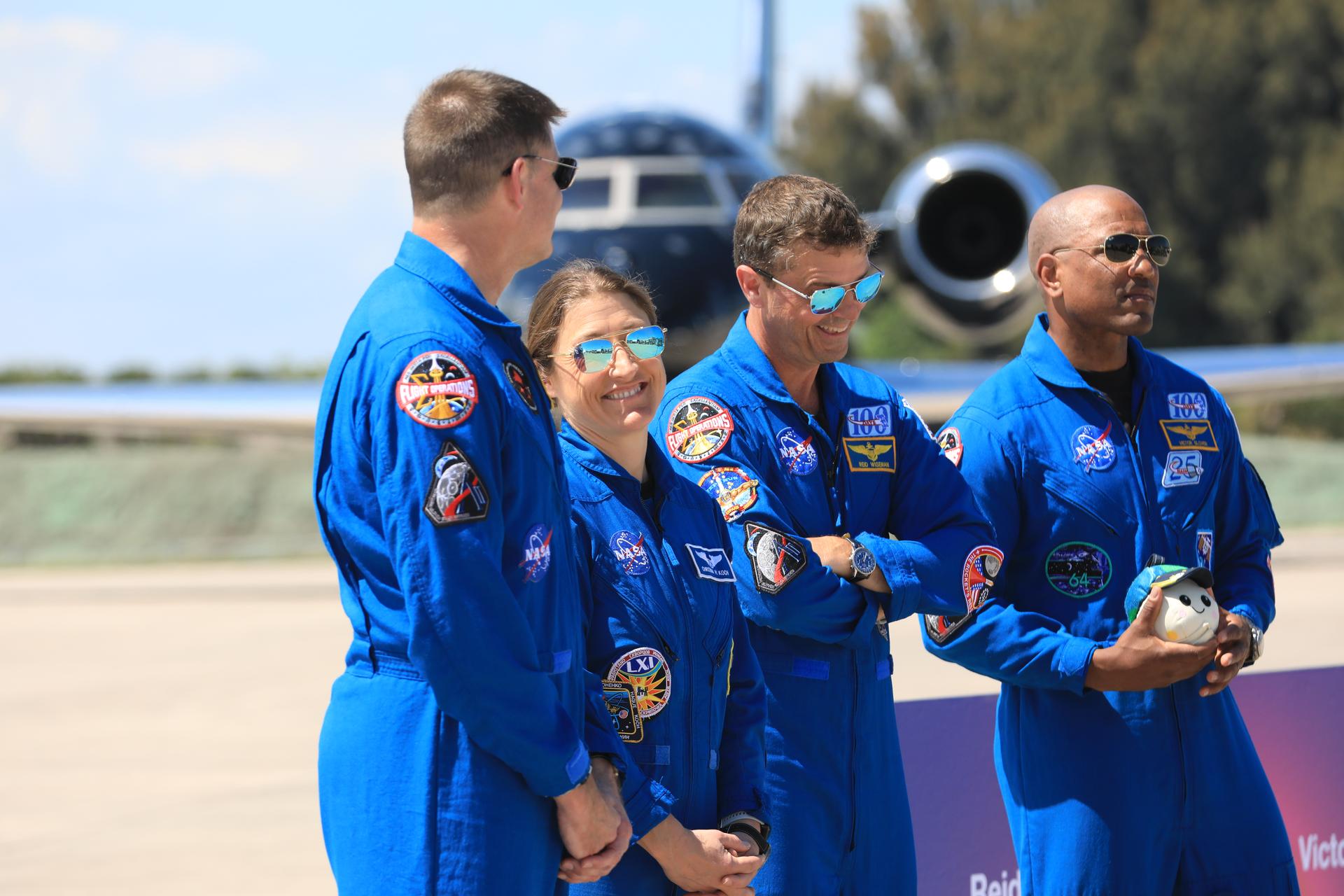

NASA’s Artemis II crew launched Wednesday on a mission built around testing. The agency picked Reid Wiseman, Victor Glover, Christina Koch and Jeremy Hansen for that mission, the first crewed Orion flight around the moon.
Given the nature of the testing mission, it’s not by chance that aviation features strongly in their backgrounds. Three of the four come directly from military flight careers, and two of those were test pilots. The fourth, Koch, built her career in engineering and field operations, rounding out the crew with experienced pilots and technical depth.
That pattern of aviation-heavy backgrounds, particularly on test missions, is not new. NASA historian Jennifer Ross-Nazzal notes that the first Mercury astronauts were all test pilots, and writes that “astronauts with backgrounds as test pilots have traditionally been among those selected to fly new spacecraft for the first time.”
She also points out why that matters; test pilots are used to evaluating unfamiliar vehicles, monitoring systems and collecting the sort of data a program needs when it is still proving itself. Artemis II is exactly that kind of mission. It is a crewed test flight intended to show how Orion and the wider Artemis system perform with people on board.
The pilot through-line
Start with commander Reid Wiseman, a retired U.S. Navy captain whose pre-NASA career ran through fleet aviation and test work. He became a naval aviator in 1999, flew the F-14 Tomcat, supported operations in the Middle East and later attended the U.S. Naval Test Pilot School. He then worked as a test pilot and project officer at VX-23, with flight test work involving the F-35, F-18 weapons separation, ship suitability and the T-45 Goshawk.
Pilot Victor Glover arrived with a similar structure in his resume, though the details differ. He earned his wings in 2001, flew the F/A-18C and later attended the Air Force Test Pilot School as a Navy exchange pilot. NASA’s biography says he has logged flight hours in more than 40 aircraft, along with completing more than 400 carrier arrested landings and 24 combat missions.
Jeremy Hansen, the Canadian Space Agency astronaut on the crew, comes from a different national service but a comparable aviation path. His CSA biography describes Hansen as a fighter pilot who completed CF-18 fighter pilot training and later served with tactical fighter squadrons and in combat operations. He also holds an Airline Transport Pilot certificate. Hansen gives the crew another member accustomed to operating fast, advanced aircraft in structured, demanding environments.
Why test pilots keep showing up
There is a reason new spacecraft keep drawing crews with flight-test DNA. Ross-Nazzal’s account of NASA’s astronaut selections points to the broader institutional logic. The agency’s early human spaceflight programs leaned heavily on test pilots because they were already used to assessing machines that were not yet fully known quantities. Bob Gilruth, whom she quotes, called that decision “one of the best decisions in the program,” because it made it “simple and logical to delegate flight control and command functions to the pilot” of the spacecraft. Artemis II is not Mercury, and Orion is not a capsule in the 1959 sense, but the underlying requirement is certainly clear enough.
That does not mean Artemis II is only a pilots’ mission. It is a crewed systems test of a spacecraft, launch vehicle and operations architecture intended for missions that follow. Even so, aviation backgrounds, particularly in test flight, though certainly from across the rest of the field as well, bring comfort with checklists, cockpit discipline, crew coordination and the habit of staying analytical while the vehicle is still teaching its operators what it wants.
The crew is not only about flying
Christina Koch is the useful counterpoint, because her route into Artemis II did not begin in a cockpit. NASA describes her as an engineer and explorer whose pre-astronaut work covered space science instrument development, Antarctic and Arctic field engineering, NOAA assignments and technical outreach. Even if she did not come from the world of aviation, she certainly comes prepared to test the systems of a spacecraft, having later spent 328 consecutive days in space and taken part in the first all-female spacewalks.
That balance may be the most telling thing about the Artemis II crew as a whole. Wiseman, Glover and Hansen are a good reminder of how often aviation remains the foundation for first flights and first-of-type missions. Koch shows that NASA still builds crews around broader technical capability as well.
As NASA sends people to test a spacecraft on its first crewed trip beyond low Earth orbit in more than 50 years, they still place a high premium on people who have already spent years learning how to master aircraft. For Artemis II, the path toward the moon runs through engineering, training and spacecraft operations.
But for most of this crew, it also runs very clearly through an airplane.


0 replies