











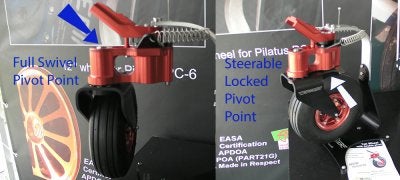
Berringer, which produces wheels and brakes, including an anti-lock system for Cirrus aircraft, is currently acquiring worldwide patents for a new tailwheel that the company believes could greatly reduce the possibility of ground-loops in taildragger aircraft. The system is built as a drop-in replacement for Scott tailwheels, which it matches in weight and attachment configuration. Where the Berringer differs is in its use of two pivot points. With the tailwheel “locked” (fixed with springs, but steerable within limits), the system provides a pivot point that is in-line with the wheel’s axle. Because there is no caster in that configuration, side loads do not translate into forces that would cause the tailwheel to turn, says Berringer. So, when locked, the tailwheel should track straight in any side load condition that does not cause the tire to skid. But the same tailwheel also has a castering feature, and that’s where the patent comes into play.
When the lock is released (via a cable that runs to the cockpit), the tailwheel becomes free to pivot around a different, forward pivot point on the tailwheel assembly. And in that configuration it is a castering, trailing, full-swivel tailwheel. Berringer says the design has already earned interest from manufacturers. We spoke with Aviat Aircraft’s Stuart Horn, who said he was interested in the design but must reserve judgment until he has the chance to work with the tailwheel. Horn said his immediate concerns were with any new complications the system might introduce. Those included any potential maintenance issues, pilot/system interactions, and how the design might behave in certain specific conditions and scenarios. Horn’s concerns were typical of his approach to any new product. The determining factor, he said, would be whether the new tailwheel delivered demonstrated advantages that outweighed the likelihood and degree of potential disadvantages.