














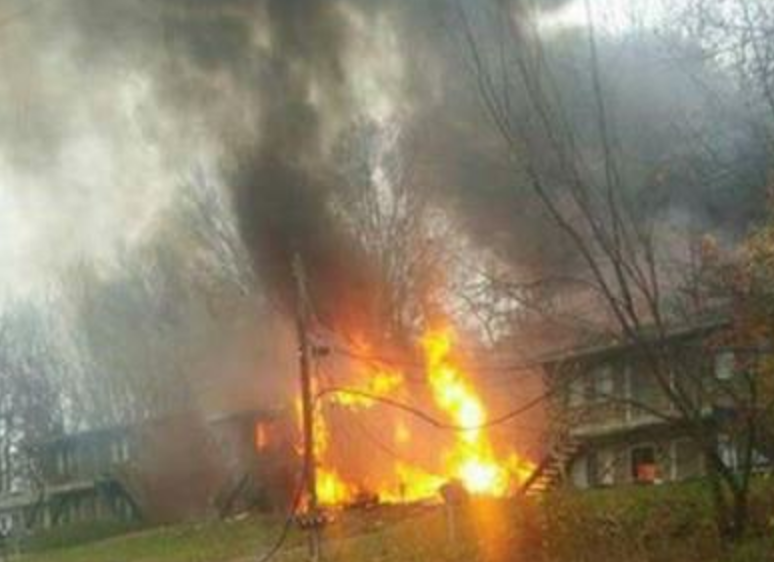
The crew of a Hawker 700A jet that crashed in Akron, Ohio, a year ago showed a “disregard for safety,” NTSB Chairman Christopher Hart said today, and the company where they worked also “fell short of their obligations.” Both crew members and all seven passengers died when the jet crashed into an apartment building about 1.8 miles short of Runway 25 at Akron Fulton International Airport on Nov. 10, 2015. The crew worked for Execuflight, which operates charter flights under Part 135. The first officer flew the approach, the NTSB said, and failed to follow checklists. The wing flaps were set at 45 degrees instead of 25 degrees, and the rate of descent was too fast. “The first officer’s lack of awareness and his difficulty flying the airplane to standards should have prompted the captain to take control of the airplane or call for a missed approach, but he did not do so,” the board said. Both pilots had been fired by previous employers, the NTSB said, and Execuflight never checked into their past records.
The captain had failed a written test in crew resource management while working for Execuflight, the NTSB found, with a score of 40 percent. However, the company recorded his grade as 100 percent, “glossing over CRM training deficiencies that could have been corrected,” said Hart.” It is not surprising that CRM issues featured prominently in the accident flight. … The protections built into the system were not applied, and they should have been.” The safety board found that as the airplane reached the minimum descent altitude, which was about 500 feet above the touchdown zone, the airspeed was 113 knots, which is 11 knots below the minimum required airspeed, and the airplane was improperly configured with 45 degrees of flaps. The captain should have initiated a missed approach, the board said, but he didn’t. He told the first officer to level off, but when the first officer attempted to arrest the descent, the airplane stalled. About 7 seconds later, the CVR recorded the sounds of impact. The seven passengers were employees of a real-estate company based in Boca Raton, Florida.