

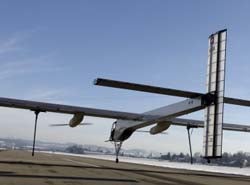
The Solar Impulse team Thursday announced plans for a multi-stop flight of its solar-powered aircraft, HB-SIA, departing the San Francisco area’s Moffett Field in early May and concluding the trip in early July at New York’s JFK. Planned stops include Sky Harbor Airport, Ariz.; Dallas/Ft. Worth, Texas; and Washington, D.C. One stop prior to D.C. has yet to be announced. Organizers hope the U.S. flight will be the last before the team embarks on a “zero-fuel round-the-world flight in 2015” with a new larger airplane. Structural failure during testing is among the team’s previous setbacks.
Last July, the larger aircraft being built to undertake the world flights suffered a cracked spar during structural tests. The failure delayed the team’s plans, but the U.S. flight may raise additional awareness about the European project. Solar Impulse chairman Bertrand Piccard and CEO Andre Borschberg are both Swiss and their efforts have so far included a 1,500-mile flight from Switzerland to Morocco that reached 27,000 feet and averaged 30 mph. The current aircraft’s wing spans more than 205 feet and is covered with nearly 12,000 photovoltaic cells that run four 10-horsepower electric motors. The cells also charge the aircraft’s lithium-polymer battery packs. In flight, the 3,527-pound plane cruises at less than 50 mph. The HB-SIA has demonstrated a duration in flight of 26 hours, 10 minutes, 19 seconds, flying overnight on power collected from the sun and stored in batteries. It has also reached an altitude of 30,000 feet and covered a distance of more than 690 miles along a course.