
















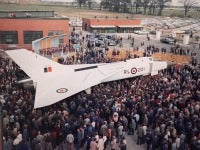
The Canadian government has rejected a proposal to resurrect a 60-year-old design for a fighter-interceptor instead of pursuing its controversial procurement of 65 F-35 Joint Strike Fighters. Bourdeau Industries, which has offices in the U.K. and Canada, first proposed building an updated version of the CF-105 Avro Arrow as a faster and all-around better alternative to the F-35. The idea has gained the support of some prominent Canadian military figures and is now being debated informally among the political hierarchy. Officially, however, the Conservative government has flatly rejected the idea, citing, among other things, the historic nature of the design and monumental task of creating the industry to build it. That industry was in place until Feb. 20, 1959, still referred to as “Black Friday” in the Canadian aviation industry. Sixty years later, the Arrow is still considered a pinnacle of aerospace achievement in Canada. It used a fly-by-wire system decades before similar systems were used in fighters and offered a computer-controlled navigation and flight management system that didn’t become common until the F-16 and F-15 era.
Faced with crushing development costs and the appealing alternative of a relatively inexpensive ramjet nuclear anti-aircraft missile known as the Bomarc, the government of the time canceled the program and ordered five test aircraft cut apart for scrap. More than 14,000 workers were terminated and many of the leading engineers went to work for NASA. One intact cockpit survives at the Canada Aviation and Space Museum in Ottawa. Rumors persist that one of the test aircraft escaped the cutting torches and is hidden somewhere, a theory that was revived in 2011 with the discovery of an Arrow ejection seat in England.

