
















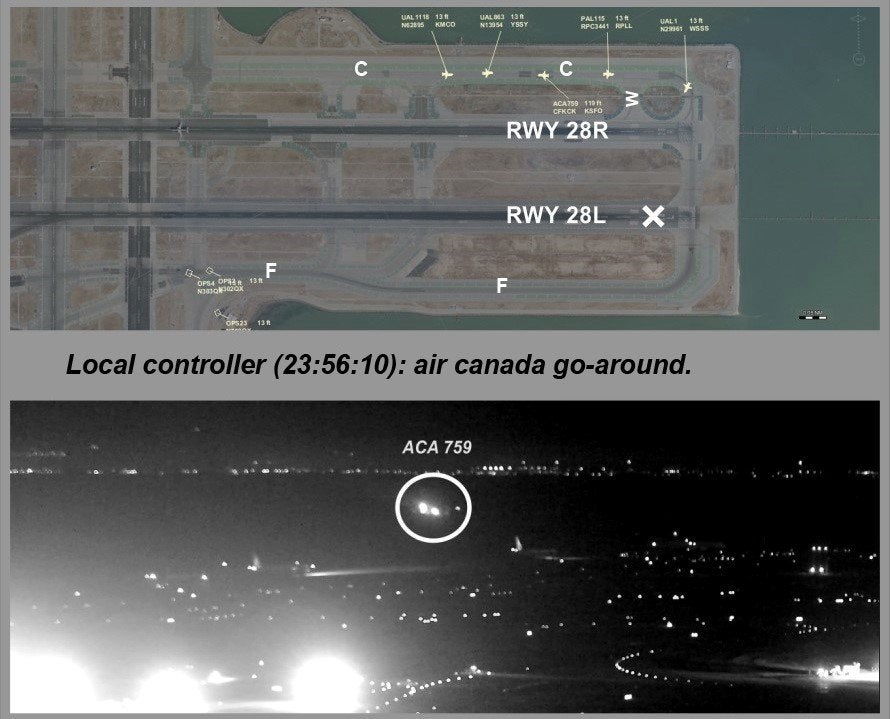
New flight recorder data says Air Canada flight 759 (ACA759), an Airbus A320, descended as low as 59 feet above ground level and the 55-foot tall 787 on Taxiway C before beginning to climb out on its go-around—coming potentially as close as four feet from a collision. At four minutes to midnight on July 7, ACA759, which had been cleared to land on Runway 28R at San Francisco International, instead lined up on Taxiway C, on which three aircraft were holding for takeoff. After prompting by one of the pilots of United Flight 1 (UA1), the first in line for takeoff on Taxiway C, who was well positioned to see that ACA759 was not headed toward a runway, the tower controller instructed ACA759 to go around. After advancing the thrust levers at 85 feet above ground level, the aircraft continued to sink to a minimum altitude of 59 feet, before overflying at least two more aircraft. Altitude figures in the NTSB report are likely based on the A320’s radar altimeter, according to an A320 pilot who spoke with AVweb about the incident. The extent to which the accuracy of the radar altimeter may have been influenced by extremely close proximity to aircraft underneath has not yet been reported by the NTSB.
According to initial interviews with the flight crew, both pilots appear to have been confused by the absence of lighting on Runway 28L, which had been closed for construction. Its lights were turned off at the time of the incident, and a 20.5-foot wide flashing X had been placed near the threshold. The Air Canada pilots reporting believing that Runway 28R was actually 28L and they therefore believed that Taxiway C was Runway 28R. According to the NTSB, the pilots “did not recall seeing aircraft on Taxiway C but that something did not look right to them.” At 0.7 miles from the runway, the Airbus crew had asked the tower to confirm there were no aircraft on 28R and that they were cleared to land. The NTSB only learned of the incident two days after the fact, at which point the cockpit voice recorder had been overwritten by subsequent flights.

