
















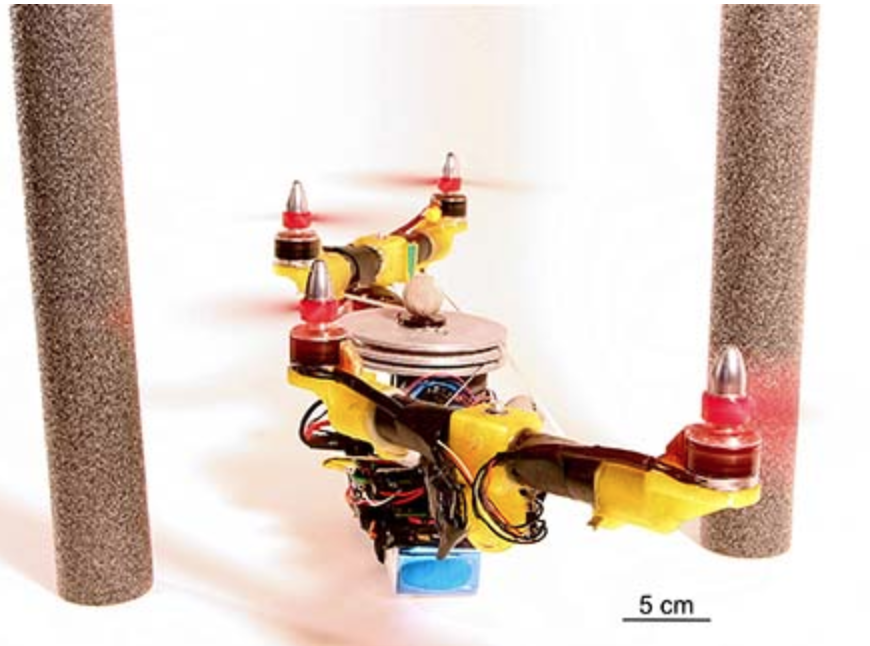
Researchers in France have developed a drone that can reorient its arms in flight to alter its profile, enabling it to reduce its wingspan and navigate in tight spaces. The “quad-morphing” design comprises two rotating arms, each equipped with two propellers, for helicopter-like flight. A system of elastic and rigid wires allows the robot to change the orientation of its arms in flight so they are either perpendicular to or parallel to its central axis. It adopts the parallel position, halving its wingspan, to traverse a narrow stretch and then switches back to the perpendicular position to stabilize its flight, all while flying at a speed of about 5 knots, “which is pretty fast for an aerial robot,” according to the institute’s news release. The researchers at the Ettiene Jules Marey Institute of Movement Sciences said they drew inspiration from birds.
The precision of the quad-morphing autopilot mechanism determines the robot’s agility, the researchers said. The autopilot activates arm reorientation when the robot nears a tight passage, as determined by a 3D localization system. The researchers have also equipped the robot with a miniature camera that can take 120 pictures per second. In the future, this will enable the drone to independently assess the size of the gap before it and fold its wings accordingly if necessary. Flight testing with the new camera will begin this month. The goal is to create large drones that can move through complex spaces for use in exploration, mapping, or search and rescue missions. The researchers have posted a video that shows the drone morphing to fly through narrow passages.

