
















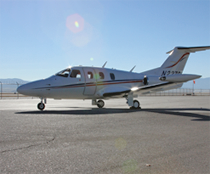
When the original Eclipse jet was certified, back in 2005, the FAA approved the airframe for a 10,000-hour lifetime, and last week, the owners of Eclipse Aerospace said the FAA had agreed to double that. “An actual Eclipse jet was subject to the movements, loads, and fatigue that would normally be experienced over more than 60,000 flight operations,” said Cary Winter, vice president of manufacturing. “This testing also validated the strength and superiority of our patented friction-stir-welding process.” With the new 20,000 hours/20,000 cycles limit and unlimited calendar life, an Eclipse jet that flies 400 hours a year would be approved for a 50-year lifetime.
The friction-stir-welding process replaces the requirement to manually drill holes and install more than 7,000 rivets in the airframe. Because rivet holes create opportunities for stress cracks to form, the elimination of rivet holes and the strength provided by the friction-stir-welded joint provides an airframe that is three times stronger than a traditional riveted airframe, according to Eclipse. Winter said the company invested hundreds of hours and several million dollars to achieve the approval change.

