
















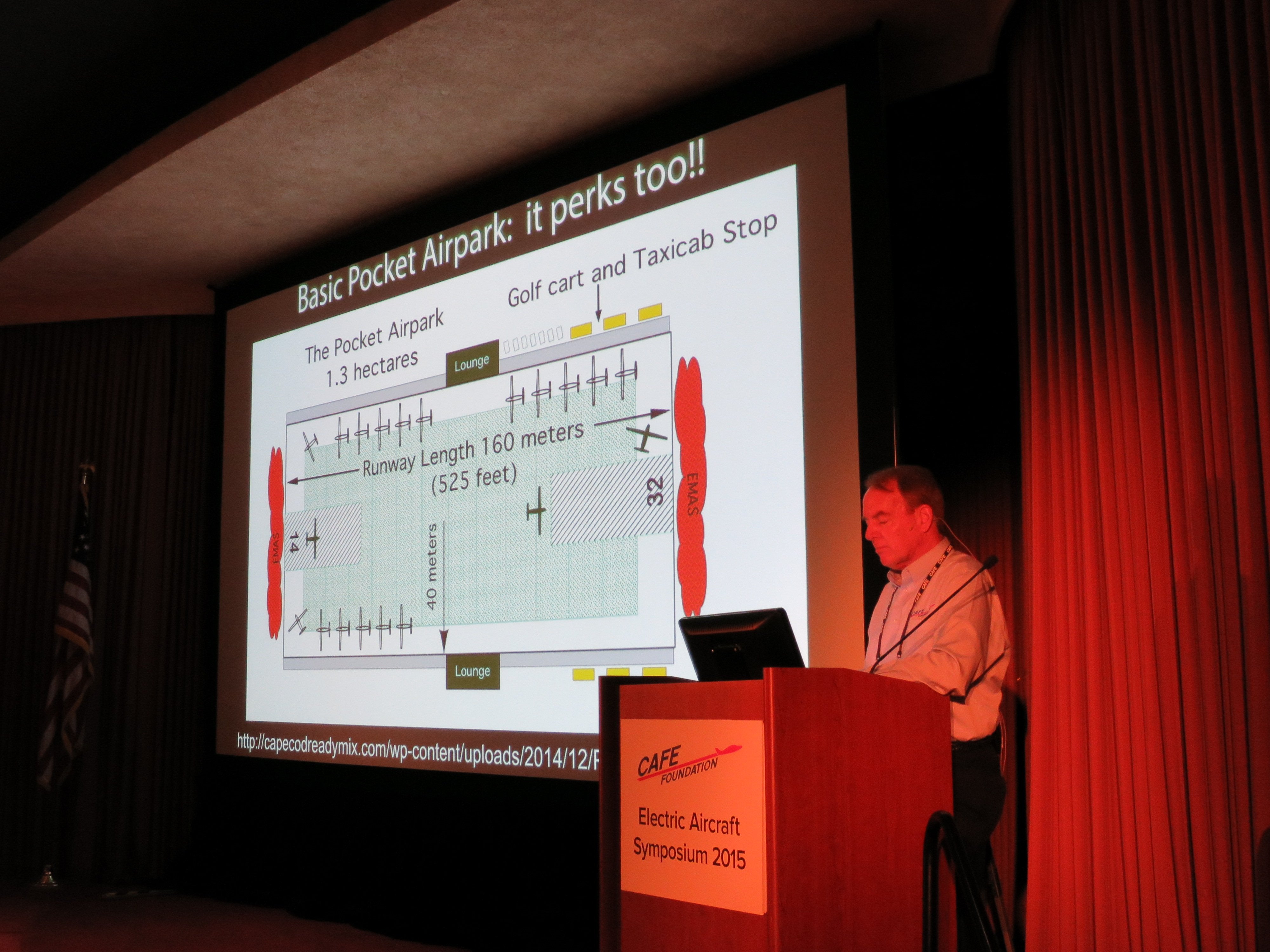
More than 160 electric aircraft industry executives, manufacturers and researchers convened at the ninth annual Electric Aircraft Symposium in Santa Rosa, California, on Friday. The symposium is organized by the CAFE Foundation, which was formed in 1981 to study aircraft efficiency. CAFE Foundation President Brien Seeley told AVweb that EAS will have record attendance this year.
“We had no idea that the 15 people in this little hotel room at a San Francisco hotel would ever grow into this,” Seeley said, recalling the first EAS in 2007. “And now, it’s kind of a tidal wave of interest, activity and basically a technological feast happening here.”
That feast is being served up by 28 expert presenters from all over the world, describing dozens of innovative electric aircraft projects.As one of the experts, Seeley’s vision is what he calls Sky Transit, a series of soccer-field “pocket airparks” linked by small electric air taxis with VTOL capability. Eventually, the Sky Transit vehicles would be fully autonomous; sort of an airborne subway system.
“If the vehicles really are emissions-free, than we don’t have to apologize for them. It’s a more sustainable way to travel than building more lanes on the freeway,” Seeley says. Although Seeley concedes barriers to the idea, he believes the technology is in place now to make the idea work.
“The mass market trips are short. They don’t require any better battery than we already have. The reality is we could implement this immediately and have a wonderful windfall when the new batteries come along. It’s here now,” Seeley says.

