
















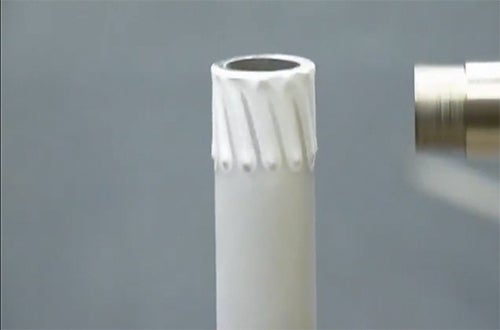
GE is researching whether cold-spray technology can be deployed to build or repair aircraft engine parts and possibly extend the lifespan of those parts (and others) by years or, more optimistically, decades. GE believes that engine parts made by cold-spray processes, also known as 3D painting, will be less expensive to produce and will be lighter and more efficient. GE also sees characteristics particular to the process that show promise for restoring damaged parts to near-original condition, including blades, shafts, propellers and gear boxes. The key lies in how the process works.
Cold-spray involves blasting particles of metal through a gun-like device at speeds beyond 2,200 mph. The process involves no welding, which avoids reheating of parts (some of which can suffer lost strength through that process), and no machining (which manipulates materials in a less efficient manner). The process is automated and has been performed with nickel alloys blasted in a stream of nitrogen and helium gas. According to GE, the process blends in materials, stacking them up in such a way that they mirror the properties of the original part. The company has been researching cold-spray at its research center in Munich, which opened in 2004. The German Government, German technology companies and Helmut Schmidt University in Hamburg have all contributed to the research.

