
















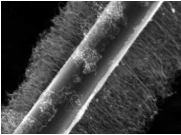
Researchers at MIT recently developed two new methodologies for creating composite materials that are both lighter and stronger than today’s materials. Their methods make it easier to create composites of carbon fibers coated with carbon nanotubes, a process that has proved problematic in the past. “Up until now, people were basically improving one part of the material but degrading the underlying fiber, and it was a trade-off,” says Brian Wardle, an associate professor of aeronautics and astronautics at MIT. Using the newly developed techniques, he said, “you can now get everything you want.” The researchers have filed for patents, and they expect that advanced fiber composites incorporating their techniques will be developed for a range of applications, including aircraft.
“There are not a lot of people innovating materials chemistry for advanced aerospace structural applications,” said researcher Stephen Steiner. “I think this is particularly exciting, and has a very real possibility to make a large-scale impact on the environment, and on the performance of aerospace vehicles.” When arranged in certain configurations, nanotubes can be hundreds of times stronger than steel but only one-sixth the weight, according to MIT’s news release. A paper about the research has been published online by the American Chemical Society (the abstract is posted, but access to the full text requires a $35 fee).

