
















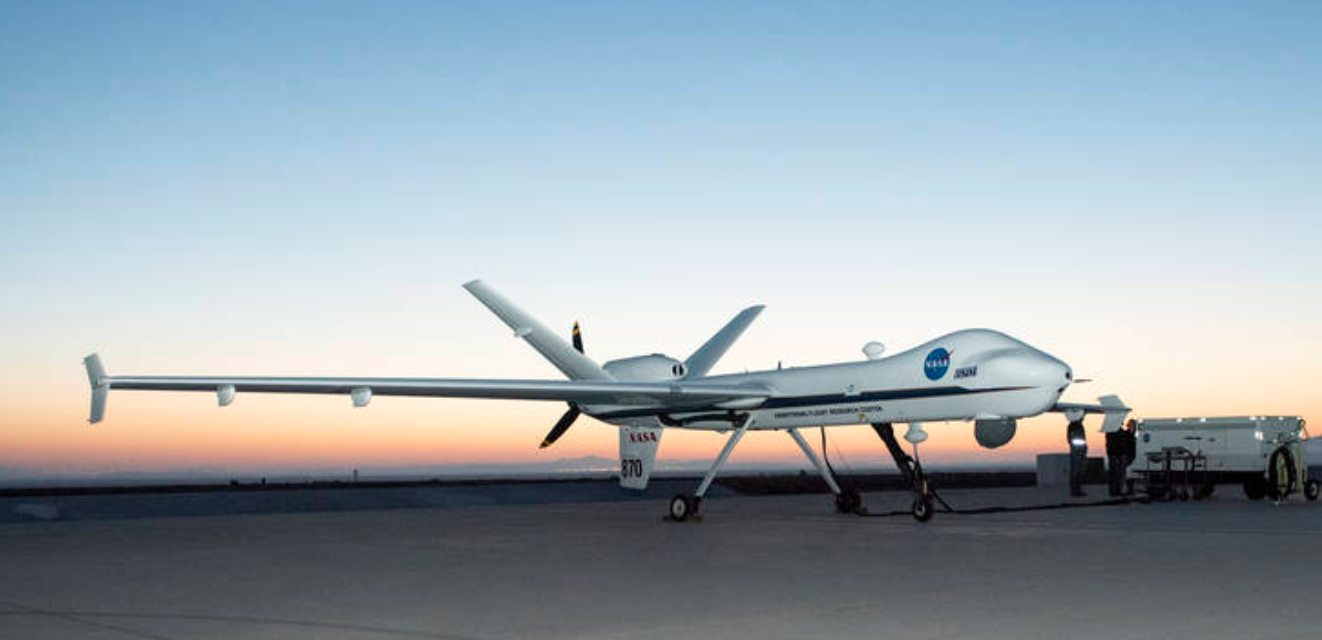
A recent test flight in the National Airspace System with a drone that was operated remotely showed that a chase aircraft is not needed for safety, NASA reported last week. During the June 12 flight, the Ikhana research aircraft used its own detect-and-avoid technology as an “alternate means of compliance,” NASA said. Previously, flying remotely operated aircraft below FL 180 could only be done with a chase aircraft because of the FAA’s “see and avoid” requirement. The Ikhana aircraft, based on the Predator drone, is about 36 feet long with a 66-foot wingspan and a gross weight of 10,500 pounds. During the test, the aircraft flew for about two and a half hours at altitudes up to 20,000 feet, and covered about 415 miles outside of restricted airspace, according to NASA.
The flight took off from NASA’s Armstrong Flight Research Center at Edwards Air Force Base in California and flew into Class A airspace just west of Edwards at an altitude of about 20,000 feet. The aircraft then turned north toward Fresno, and air traffic control was transferred from the Los Angeles Air Route Traffic Control Center to the Oakland Air Route Traffic Control Center. “The transfer was smooth as if the pilot were onboard,” according to NASA’s report. On the return trip, the UAS headed south and back to Los Angeles Center control, then began a gentle descent above Tehachapi into Class E airspace, at about 10,000 feet. Transiting Class D airspace, the remote pilot initiated an approach into Victorville airport at 5,000 feet, coordinating in real time with air traffic controllers. After successfully executing all of these milestones, the aircraft exited the public airspace and returned to its base at Armstrong.
Air-to-air radar, TCAS and ADS-B technologies are the three main technologies that enabled Ikhana to accomplish this mission, NASA said. Ikhana was the first aircraft to use these sensors and a detect-and-avoid algorithm as analternate means of compliance to FAA “see and avoid” rules.

