
















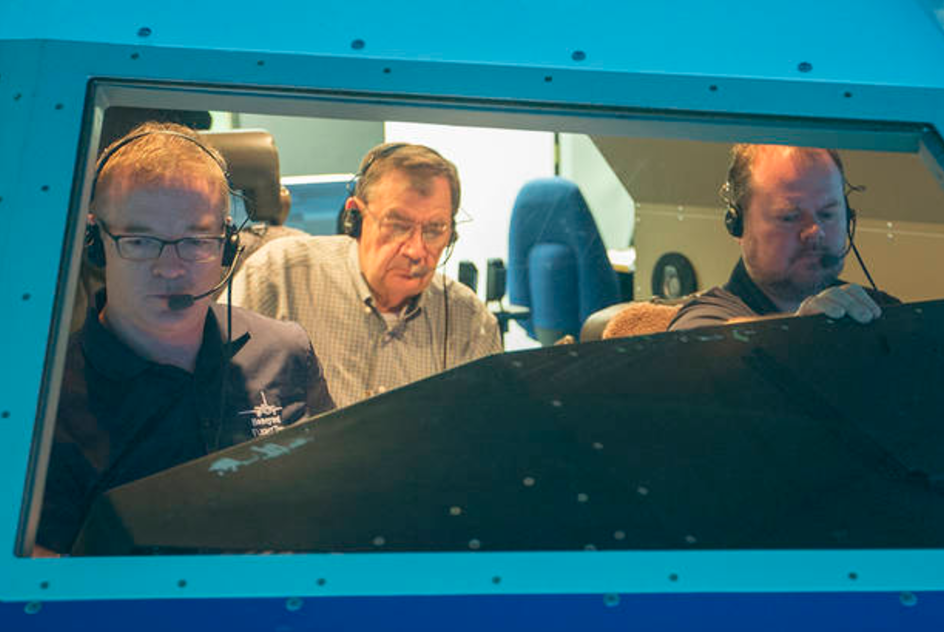
NASA said this week they are ready to start airborne tests of new cockpit technology that aims to help air traffic controllers manage landings more efficiently. After years of research and lab tests, a full airborne demo of the system is scheduled to fly later this month over Washington state. The flight crews will be using software developed by NASA that directs pilots to fly at a certain speed and maintain a precise spacing with an aircraft flying ahead of them, all the way down to the runway. “It’s a very simple ‘follow the leader’ operation that is easy to execute by the flight crew,” said Sheri Brown, manager of the project at NASA’s Langley Research Center in Virginia.
During the course of the flight tests, researchers hope to complete some 80 runs involving three major flight scenarios: flying at a cruise altitude of 35,000 feet, descending from cruise altitude all the way down to the airport, and making a final approach beginning about 15 minutes before touchdown. “All the pilots that are going to be flying the FIM [Flight Deck Interval Management] operations have gone through the training modules and simulations,” said Brown. “The equipment is all set and we’re ready to go.” The flight test will take place about 120 miles due east of Seattle over Grant County International Airport.
NASA will fly three aircraft in the tests, including a Boeing 737 provided by United Airlines and two airplanes provided by Honeywell — a Boeing 757 and a business jet, either a Dassault Falcon 900 or an Embraer 170. All anticipated flight operations have been fully coordinated ahead of time with all involved FAA air traffic control facilities. The plan is to fly about five and a half hours each weekday from Jan. 20 to Feb. 28, testing up to five scenarios during each daily sortie. If all goes well with the demo, the entire FIM system – including software and hardware – will be turned over to the FAA by the fall of 2017. The FAA will continue to evaluate and test it before making a decision to certify its use.

