
















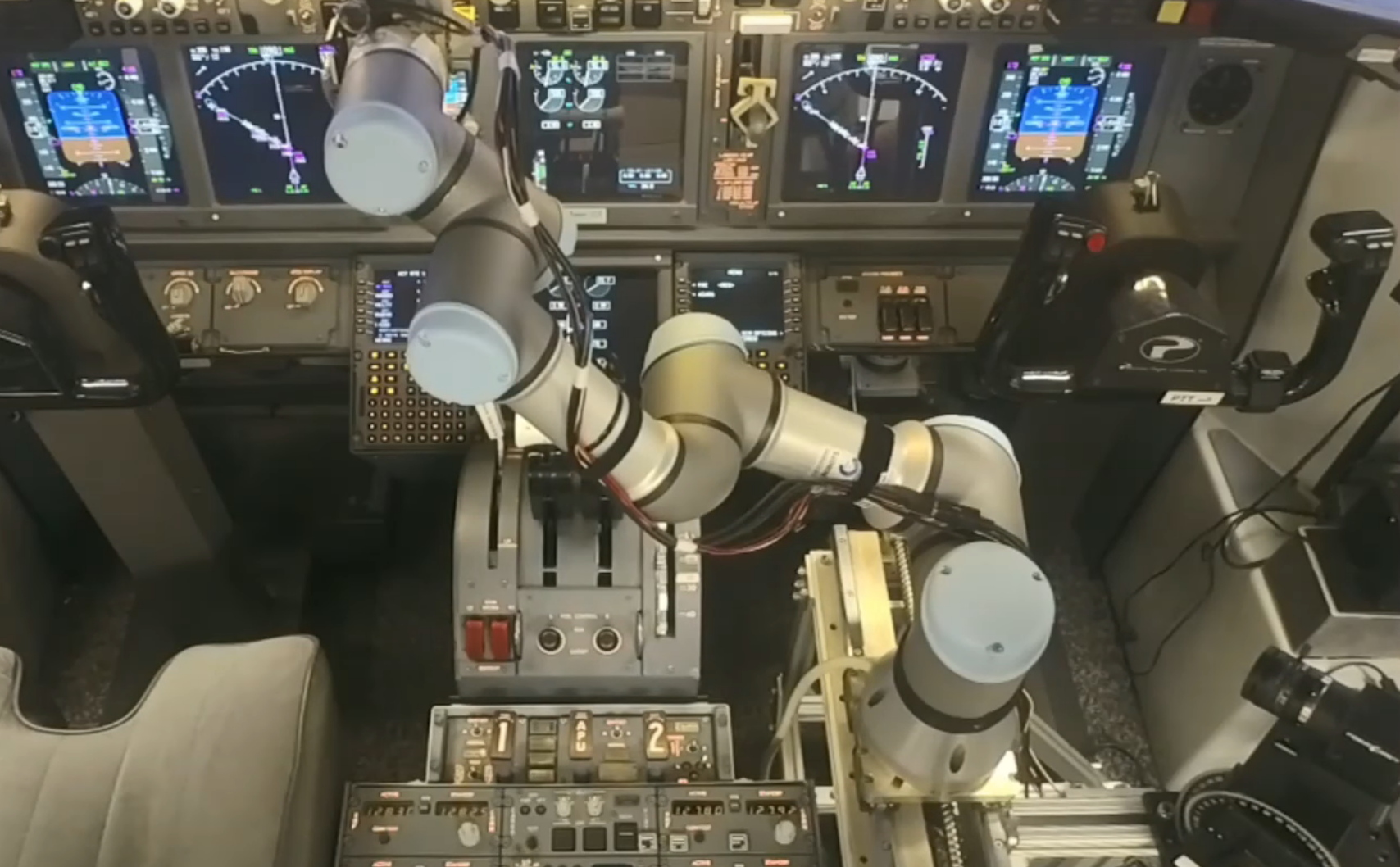
Aurora Flight Sciences has successfully tested a robotic copilot in a Boeing 737 simulator, demonstrating that it can safely land the airplane on its own, the company said this week. The system is designed to function as a second pilot in a two-crew aircraft, enabling reduced crew operations while ensuring that aircraft performance and mission success are maintained or improved. Aurora is working with the Defense Advanced Research Projects Agency to develop the technology. DARPA has said their goal is to test “a tailorable, drop-in, removable kit that would promote the addition of high levels of automation into existing aircraft.” Aurora has previously tested the system in a Diamond DA42, Cessna 208 Caravan, UH-1 Iroquois and DHC-2 Beaver.
“Having successfully demonstrated on a variety of aircraft, ALIAS (Aircrew Labor In-Cockpit Automation System) has proven its versatile automated flight capabilities,” said John Wissler, Aurora’s vice president of research and development. “As we move towards fully automated flight from takeoff to landing, we can reliably say that we have developed an automation system that enables significant reduction of crew workload.” Aurora’s technology includes the use of in-cockpit machine vision, robotic components to actuate the flight controls, an advanced tablet-based user interface, speech recognition and synthesis, and a knowledge-acquisition process that facilitates transition of the automation system to another aircraft within a 30-day period. Aurora is also working on a version of the system without robotic actuation that instead aims to support the pilot by tracking aircraft physical, procedural and mission states, increasing safety by actively updating pilot situational awareness.

