














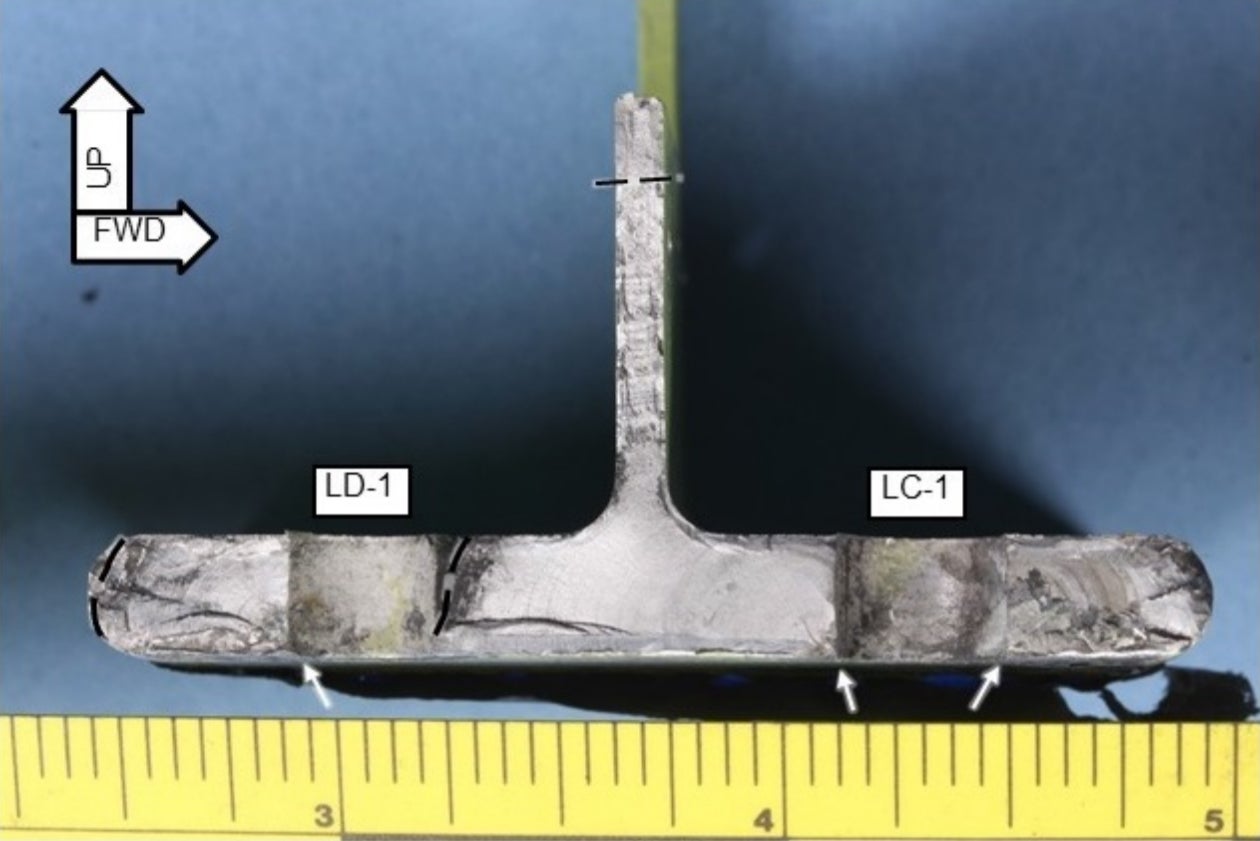

The NTSB found that the crash of an Embry-Riddle Aeronautical University Piper PA-28R-201 that killed two people in April 2018 was caused by extensive fatigue cracking in the left-wing main spar, according to the final report (PDF) issued by the board on Tuesday. As previously reported by AVweb, the left wing separated from the aircraft shortly after a touch-and-go at Florida’s Daytona Beach International Airport (DAB). A second ERAU Piper was found to have a similar fatigue crack in its left-wing main spar when the school’s fleet was examined after the accident. The board noted that no anomalies in materials or construction of the wing spars were found on either aircraft.
“The NTSB concludes that, due to flight training maneuvers, significant operation at low altitudes, and frequent landing cycles, the accident airplane (and its sister airplane in the operator’s fleet) likely experienced landing, gust, and maneuver loads that were more severe than expected for training aircraft,” the NTSB said in its summary (PDF) of the report. “Therefore, the low-altitude flight training and frequent landing environment likely resulted in the accident airplane accumulating damaging stress cycles at a faster rate than a personal use airplane.”
The NTSB reported that the accident aircraft had accumulated 7,690.6 hours and 33,276 landing cycles prior to the crash, averaging 4.33 landings per hour of flight time. The board also found reports of reported flap extension overspeed, gear extension overspeed and hard landing events in the aircraft’s logs, but noted that airframe inspections had been performed after each event with no defects noted.
The NTSB further established that, due to its location, the fatigue cracking would not have been visible from either the interior or exterior of the airplane. In response to the potential for such cracking to go unnoticed, the FAA issued a notice of proposed rulemaking (NPRM) eight months after the accident which suggested required wing spar inspections for nearly 20,000 Piper PA-28 series aircraft. The NTSB said it had “expressed … support of the proposed AD’s inspection requirements but urged the FAA to reexamine the proposed AD’s applicability to certain airplanes based on airplane usage.” Comments closed on the NPRM in February 2019, but an AD has not yet been issued.
