














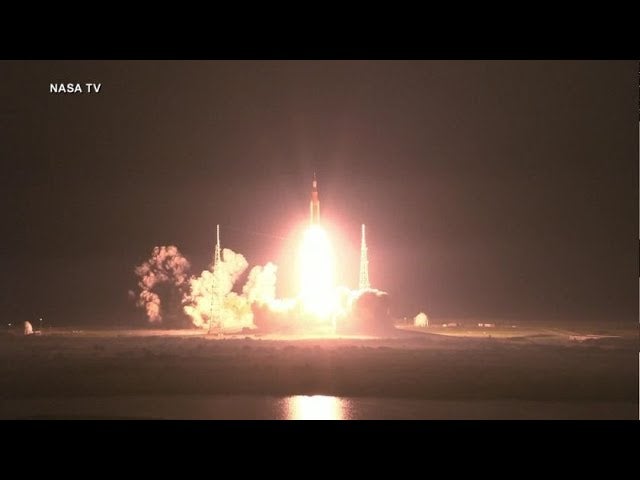

After months of delays and in a spectacular nighttime launch, NASA sent its new Space Launch System on its inaugural mission early Wednesday morning. The booster lifted off at 1:47 a.m. Eastern time on a 26-day mission. Although the rocket carried NASA’s new Orion crew capsule, the mission is being flown with instrumented mannequins.
Shortly after launch and as scheduled, the booster’s upper stage, called the Interim Cryogenic Propulsion Stage, separated and performed an 18-minute translunar injection burn to put the spacecraft on a lunar trajectory. The ICPS will coast behind the Orion spacecraft and is carrying 10 small cubesats that will be deployed on the trip to the moon. Some of these will collect lunar data and one will deploy a solar sail to fly by an asteroid. NASA said Orion successfully deployed the solar arrays which will power it.
The primary goal of Artemis I is to test the booster itself, a mashup of components from the retired Space Shuttle system, and operate the Orion in deep space, testing its heat shield and recovering the spacecraft in anticipation of a crewed mission on Artemis 2 no sooner than 2024. The successful launch ends years of delays. The SLS was originally intended to fly in 2016.
