















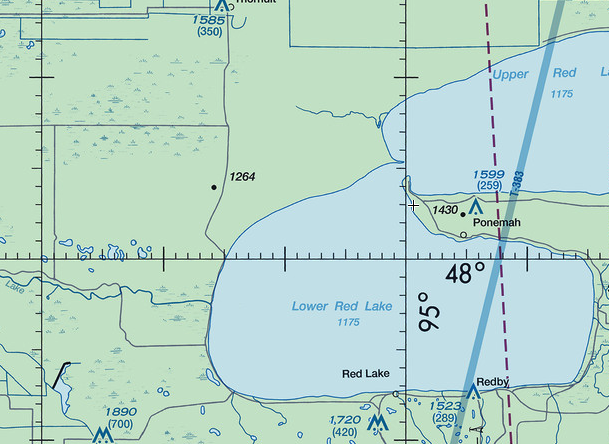

A Minnesota pilot whose aircraft was impounded after an emergency landing on the Red Lake Reservation last October has declined a settlement proposal offered by Red Lake Nation. According to local PBS Lakeland News, Roseau pilot Darrin Smedsmo said the agreement would have required a $5,000 donation to the Red Lake Boys & Girls Club along with payment of a $2,750 towing fee in exchange for the release of the airplane.
“Well, I finally, finally, received a proposed settlement, and it was—it wasn’t acceptable,” Smedsmo told Lakeland News. “It wasn’t even a place to start with.”
Smedsmo was flying from Roseau to Bemidji, Minnesota, on Oct. 15 when the engine of his 1946 Stinson 108 failed at roughly 3,500 feet, forcing him to land on a road near the western edge of Lower Red Lake within the reservation. Tribal authorities responded to the scene and later impounded the aircraft, citing a 1978 tribal resolution that they argue prohibits aircraft from flying below 20,000 feet over Red Lake Nation lands.
In a statement issued Nov. 3, Red Lake Nation said the aircraft seizure occurred after it landed on reservation land “without prior authorization or required coordination with Tribal authorities” and that the situation created “immediate safety, liability, and resource-protection concerns.”
Smedsmo said the proposed agreement also stated that he had been given an opportunity to appear in tribal court, which he disputes.
“The fact was that I didn’t,” he told Lakeland News. “They called the court off. So, you can’t even start with a document like that. And then I was supposed to pay a fee, and I’m just not going to do that.”
The aircraft has remained impounded since the October landing.
AOPA asked federal officials in December to assist with resolving the aircraft seizure situation, citing federal authority over navigable airspace and requesting discussions with tribal leaders regarding procedures for emergency landings.


I don’t think there are many if any reservations, which don’t rely on air ambulance services. The FAA should threaten to suspend their operating certificates unless this resolution is rewritten with an emergency exemption. Once Big Chief realizes his squaw might not get late night transport to a Metro Medical Center in the event of pregnancy complications he should relent.
This is precisely the kind of situation in which the FAA must intervene, both to reaffirm that authority over navigable airspace rests exclusively with the federal government and to make clear that the tribal resolution—purporting to assert jurisdiction over the airspace above their lands up to 20,000 feet—has no legal effect.
Most reservations have infrastructure easements that allow crossing the reservation. Aerial navigation should qualify as infrastructure.
Take away their casinos
Unfortunately this is a perfect example of how much the FAA thinks of piston engine GA. That’s what happens when a former airline executive is appointed Administrator.
This is a problem that far above and began long before the FAA and genav itself. The movement among indigenous tribes to declare themselves “First Nations” has been allowed - even promoted - by irresponsible bureaucrats and politicians to gain their support. Where it went sideways is not nipping the idea in the bud that these bands and tribes were “nations” in the literal sense and were entitled to be national governments equivalent to the USA (or Canada where this has advanced much farther). IMHO on day 1 it had to be clearly established that the status of a tribe or band was that of a municipal government, not a federal, national, state, provincial or territorial status, but that of a county. The cost of sorting this mess out will be in the trillions, not the few thousand to recover this airplane. To give you an idea how I have seen this happen 45 years ago: I saw a general contractor building roads and infrastructure on a Northern MB reserve stop work because the band’s cheques contracted to be paid as work in progress were bouncing, then not even sent. The band threw the contractor’s staff off the reserve, seized all of the equipment, using the pieces they had immediate need of and destroying the rest
This issue actually goes back to the ownership of airspace. There is plenty of case law both in the IS and around the world that clearly articulates that nobody actually owns the airspace above their land, backyard, farm etc. this simply means that even though the ‘tribe’ wrote something into their own pseudo law, it is not enforceable. I wonder why the pilot hasn’t got a solicitor involved to push this issue because it would turn the ‘tribe’s assertion that nobody can fly lower than 20,000 feet over their land in disarray.
Not so much that he was a former airline executive with no real experience in the various positions within FAA but the overriding issue to me was that he lied for over 20 years about his pilot certificate and ratings ( stated in person and in various media for over 20 years that he was a commercial pilot when, in fact, he was a private pilot and then when questioned by Congress about his lie he explained that he had the training and had taken the written exam but weather precluded him from taking the check ride)- and Congress approved him anyway. PITIFUL!!!
Sadly, depending on how the aircraft has been stored since October the owner may have much more than engine issues to address when he finally does recover the aircraft.
SteveR appears to have the story correct. The tribe, not recognizing emergencies is violating the law. And the FAA should tell them that and take the tribe to court if necessary. Landing on a road is the safest possible emergency; where ever the road is. And Indian land is not exclusive of emergencies, and they should know that. And need to be told that! By everyone! Dear lord, this is very annoying, in addition to being unlawful; not having people on the same page on emergencies.
Hmm, gonna have to take away the smokes, bingo and blackjack tables I reckon.
Could your post be any more racist?