















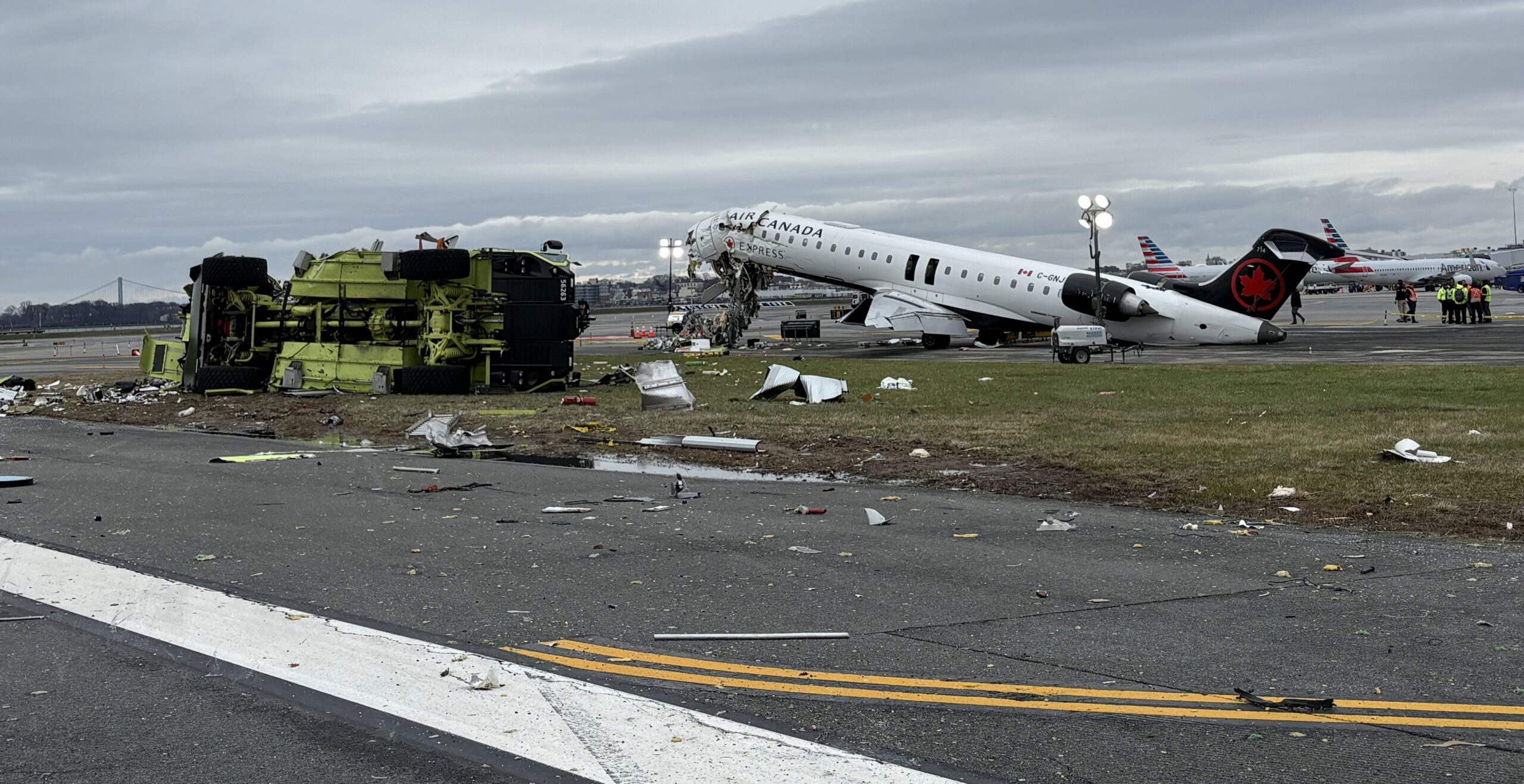

The Port Authority of New York and New Jersey says it will install transponders on fire trucks and other rescue vehicles at its three major airports following the March 22 runway collision at LaGuardia Airport that killed two Jazz Aviation pilots operating a flight for Air Canada Express.
“We recognize that transponder technology can provide an additional layer of visibility on top of existing surface-surveillance systems that already track ground movements,” James Allen, the Port Authority’s chief communications officer, said in a statement reported by the Associated Press. “We will continue to work closely with the NTSB as its investigation proceeds and remain focused on working with the FAA to strengthen safety across our airfield operations.”
The NTSB said in its preliminary report on the accident that the truck involved in the LaGuardia collision was not equipped with a transponder. Because the vehicle did not have a transponder and was moving with a larger group of vehicles, the airport’s surface-detection system unable to match the aircraft’s path with the vehicle’s path.
LaGuardia is equipped with ASDE-X, which combines radar, transponder and other data to help controllers monitor aircraft and vehicles on the airport surface.


Once again we will address the issue after tragedy.
Hopeful Congress will revisit the ROTOR act and pass that. We have the technology, we just have to stop ignoring facts due to economic concerns.
Yes… I wonder where the petty bureaucrats & politicians put those two lives & one cripple on their cost analysis spreadsheet. I wonder if even one has a pang of guilt.
Someone (like a real REPORTER) should do an access to information request and see how much paper worke there was from the airport authority, emergency services etc asking for this capability.
Tl;dr for you folks in a hurry
“Yeah so, we’re gonna have to pay money now but only because something completely and totally preventable in this century happened. Oh but were like very upset and stuff”
Scumbags. Additionally, the behavior of other employees is equally disgusting- the night of the first day they re-opened flying into LGA, leaving the terminal after a late flight (11pm) on the floating bridge connecting the main terminal to the satellite (you could clearly see the wreckage) I witnessed individuals wearing suits and SIDA badges on lamyards fraternizing with other terminal workers by taking pictures of the wreckage on their phones and being jovial, making a spectacle out of it. They suddenly stopped when they saw me staring daggers. The only time in my life i actually felt the desire to spit on anyone. I can understand passengers doing it and not reading reading the room but these guys definitely knew better.
Searching for ASDE-X to catch-up on aviation technology, this is installed in 35 major airports around the country. Is there an explanation for fire and emergency airport vehicles not equipped with transponders in LaGuardia airport? What about the other airports?
The vehicle transponder idea isn’t even close to address this specific issue. Clearly the controller lost track of arriving traffic, he knew exactly where the firetruck was.
Maybe a simple runway touchdown clock would solve this issue. It would calculate aircraft speed and distance to provide a quick look, a learning system would eventually get the times near perfect.
“{Aircraft ID} landing 24R in [28 seconds]”
“{Aircraft ID} landing 24L in [4 minutes]”
All tagged up aircraft would be listed once they have their runway assignment. Other tagged aircraft would be listed but not with landing time.
A quick glance at this board would tell the controller 28 seconds might not be enough time for truck(s) to cross the runway.
In aviation 28 seconds is still a lot of time, but one might not trust a truck would start moving quickly enough.
If it was important enough the controller could have issued a go-around to make the crossing safe.
What took so long? People need to get killed for additional safety to be installed? More tragedy!