















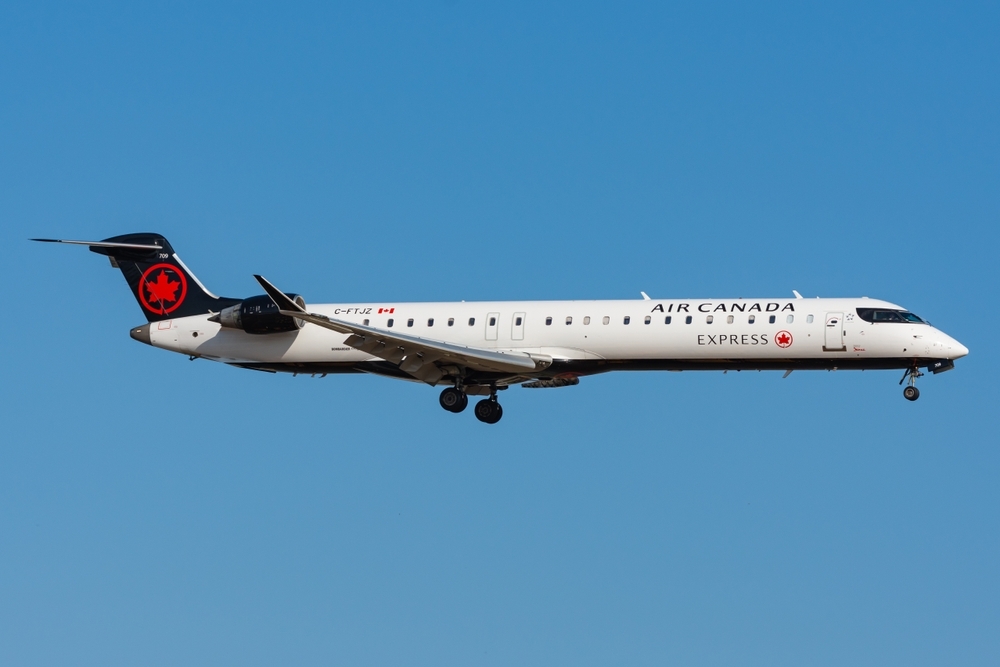

The National Transportation Safety Board on Thursday released its preliminary report on the March 22 collision between an Air Canada Express CRJ-900 and an airport rescue vehicle at New York’s LaGuardia Airport, outlining a sequence in which the fire truck was cleared to cross runway 4 as the regional jet was on short final. The accident killed the captain and first officer and injured 39 other people, including six reported serious injuries. The airplane, operated by Jazz Aviation as Air Canada flight 8646 from Montreal, collided with Rescue 35 while landing just before midnight.
According to the report, the local controller cleared the flight to land at 11:35:07 p.m. and later cleared “Truck 1 and company” to cross runway 4 at taxiway D at 11:37:04, when the airplane was about 130 feet above the ground and about one-quarter mile on final. The truck began moving after reading back the clearance.
The report says the controller then instructed Truck 1 to stop at 11:37:12 and again at 11:37:20, but the vehicle’s speed continued to increase as the airplane touched down and rolled toward the intersection. About two seconds before impact, the nose gear touched down while the truck was entering the runway.
Surface Alerts and Lighting
LaGuardia’s Airport Surface Detection Equipment, Model X, did not generate an aural or visual alert for controllers before the collision. Investigators said the group of seven emergency response vehicles could not be reliably tracked because none were equipped with transponders, and the system was unable to distinguish all of them as separate targets.
As a result, investigators said, ASDE-X could not correlate the path of the landing airplane with the track of Rescue 35 and did not predict the conflict.
The NTSB said runway entrance lights at taxiway D illuminated as the airplane approached and remained on while the response vehicles were stopped about 300 feet from the hold-short line. Those red lights extinguished about the time the truck reached the runway edge, about three seconds before the collision, the report said.
Investigators also said the rescue truck’s onboard situational-awareness display was capable of showing vehicle and aircraft locations and of providing runway-approach alerts, but that it could not issue a warning of an impending collision.
Damage and Final Control Inputs
Truck 1 turned left just before the collision, and the aircraft’s rudder deflected about 6 degrees left just before the end of recorded flight data. The regional jet’s last recorded ground speed before impact was 90 knots, according to the report.
The preliminary report said the most severe damage to the CRJ-900 was forward of the first passenger row. The cockpit area sustained crush damage and the two pilot seats were found separated from the airplane. Investigators reported no anomalies with the airplane’s pitch, roll or yaw flight-control surfaces, and said the slats and flaps were fully extended and both thrust reversers were deployed.
Tower Workload, No Alert
Investigators said there were two controllers on duty, consistent with the mid-shift schedule. The ground controller, who was also the controller-in-charge, was handling a separate emergency involving an airplane that had performed two rejected takeoffs and then declared a ground emergency at Terminal B. While that continued, the local controller was transmitting on both the ground and local control frequencies, the report said.
This was the NTSB’s preliminary report, meaning the accident remains under investigation and that any information contained within it is still subject to change.


FIRE TRUCK Driver to mates on truck as truck approaches runway to cross: “See anything on final?” Mate responds: “I can’t see anything because of those blinding headlights on the runway.” Same for the Army helo crew that collided head-on with the American Airlines CRJ on final to Washington National. “I can’t see anything because of those blinding headlights” coming sraight at us.