















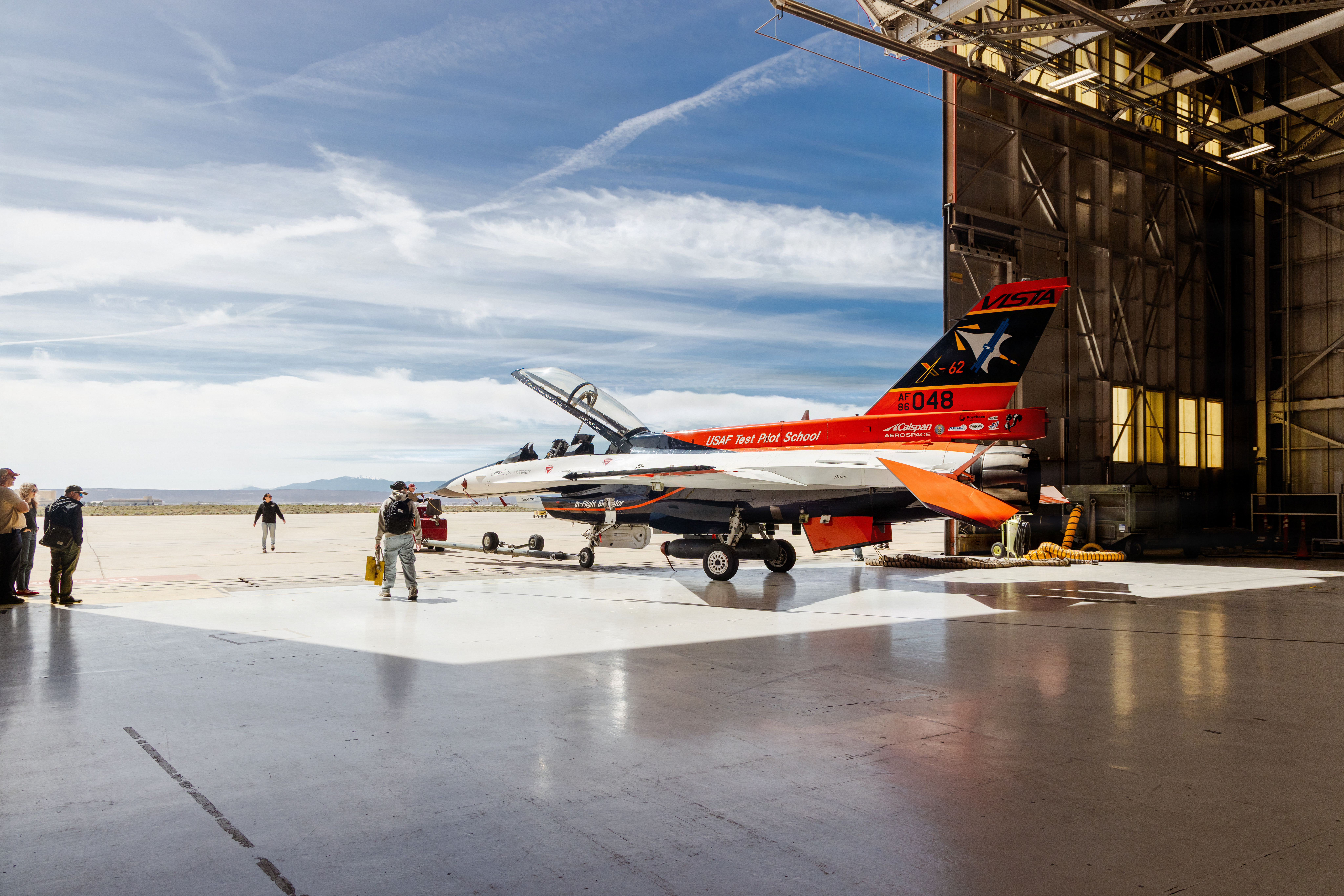

The U.S. Air Force said Tuesday that its X-62 VISTA experimental aircraft completed 27 AI-controlled intercepts during eight flights at Edwards Air Force Base in April. During the tests, an artificial intelligence agent used live infrared sensor information to autonomously maneuver the aircraft against a T-38 target.
From Sensor To Flight Controls
The HAVE HEAT test program used Lockheed Martin’s Legion Pod, an infrared search-and-track sensor carried by the X-62. The sensor tracked the T-38 and supplied its data to the AI agent aboard the aircraft. According to Lockheed Martin, previous autonomy testing relied more heavily on simulated target information, while the April flights allowed the AI system to respond directly to information coming from an operational airborne sensor.
“HAVE HEAT represents a meaningful expansion of avionics capability towards integrated, AI-driven control of multiple sensors and air vehicles for mission autonomy,” Lt. Col. Joshua Strafaccia, dean of faculty for research at the Air Force Test Pilot School, said. “This bridges a capability gap and positions us to test advanced autonomy faster.”
Testing The Safety Boundaries
A second program, called HAVE HOLIDAYS, ran alongside the intercept testing. Engineers installed a third-party autonomous agent in the X-62’s Enterprise Open Mission System Architecture computer and evaluated safety rules intended to prevent autonomous aircraft from exceeding limits established by operators. The program also tested additional computing hardware for processing sensor information. The Air Force said ground testing for the two programs was completed within three months.
The X-62 is a heavily modified Block 30 F-16D that has served for decades as a variable-stability flight-test aircraft and more recently as an autonomy testbed. It was previously used in human-versus-AI air combat testing under DARPA’s Air Combat Evolution program.
Planned upgrades now include an RTX PhantomStrike radar, additional computing and sensor capacity and modern network data communications. The Air Force Test Pilot School and Test Resource Management Center are scheduled to hold their first X-62 Research Symposium at Edwards from Aug. 11-13.


I worked on the original VISTA team while at Lockheed Martin (then General Dynamics) in the late 80’s, early 90’s. It is good to see that 40+ years later, the test bed is still being used.