















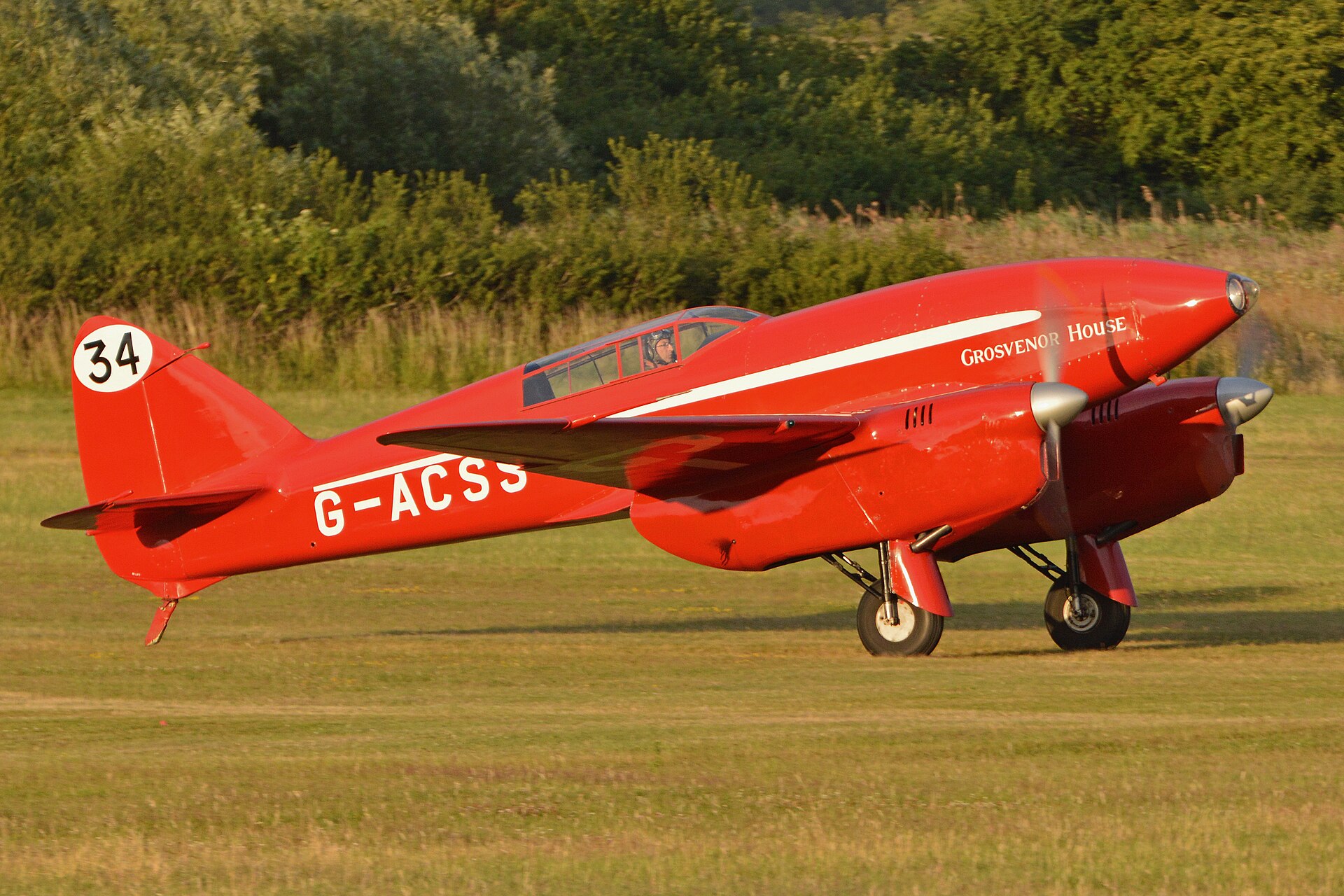

The last airworthy original de Havilland DH.88 Comet was involved in an accident Saturday during an airshow at Old Warden Aerodrome in Bedfordshire, England. The aircraft, G-ACSS “Grosvenor House,” was the winner of the speed prize in the 1934 MacRobertson Air Race from England to Australia.
Pilot Discharged From Hospital
The accident occurred at approximately 7:20 p.m. local time during the Shuttleworth Flying Proms. One person was aboard the aircraft.
BBC News reported that the pilot was removed from the aircraft and transported to a hospital for evaluation. The pilot was discharged Sunday.
“Following yesterday’s incident at our Flying Proms Air Show (15.08.2026), we can confirm that the crew member involved has been discharged from hospital,” the Shuttleworth Trust said Sunday in a statement posted on X.
Shuttleworth said additional information on the condition of the aircraft would be released later.
1934 Race Winner
De Havilland developed the twin-engine DH.88 specifically for the 1934 MacRobertson Air Race, which ran from England to Melbourne, Australia. Only five DH.88s were built. C.W.A. Scott and Tom Campbell Black flew Grosvenor House to the race’s speed prize in 70 hours and 54 minutes. The aircraft was later evaluated by the Royal Air Force and subsequently used for additional long-distance record flights before entering the Shuttleworth Collection in 1965.
Grosvenor House returned to flight in 1987 following a restoration that lasted more than a decade. It experienced a landing gear failure at Old Warden in 2002, and subsequent research determined the original landing gear legs could fail under certain conditions, according to Shuttleworth. The aircraft returned to flight in 2014 after structural modifications.
The other surviving original DH.88, G-ACSP “Black Magic,” remains under restoration to airworthy condition.


Glad the pilot is OK but that’s why you shouldn’t fly those rare birds anymore. Statistics catch up eventually, count on it. They lost them left and right back then so why think they’re invincible now.
What of the Aircraft? Was it destroyed? Is it Repairable…?
Of course glad the Pilot is ok!
From another source:
The aircraft nosed over and inverted while landing on the grass runway.
The aircraft sustained substantial damage , including a sheared-off tail and structural damage to the rear fuselage. The Shuttleworth Trust stated that any further updates on the aircraft’s repairability would be issued in due course.
Hopefully there is interest in restoring such an Historic relic!
Two left out of 5 built since 1934 isn’t too bad, given the ravages of time. How many were scrapped? How many were lost to mishap? How many were parted out? How many simply succumbed to environmental issues? How many were simply junked?
Not quite accurate, and though an emotional response is always understandable, vintage aircraft are far more intricate than “old toys”. A brief review of the Comets and their fates is in order.
The MacRobertson race was a huge ask, from England to Australia, and three were made for private owners using the most modern of manufacturing techniques. They were sold at a fraction of their true cost to show the dominance of British aerodynamics and engineering. Three were made for the race, and two built after the race for foreign government mail use. The race was a perilous affair with several aircraft being lost though the winner of the race, Comet G-ACSS “Grosvenor House” validated the effort.
Comet G-ACSP was the Mollison couple’s entry and they retired the aircraft “Black Magic” with engine trouble in Pakistan. Post race she was sold to Portugal as CS-AAJ. She disappeared and was located in a stunning find for aviation historians and has been under restoration since 2020 or so.
Comet G-ACSR was a green aircraft that was fourth in the race and set a record returning to England. Sold to France it became F-APNY and was last seen in derelict condition at Estampes France as the Germans rolled in…she didnt survive the war.
The French ordered a fourth example as a mailplane and registered her as F-ANPZ. She perished in a hangar fire June 1940. That fire may have been intentionally set to prevent the aircraft going into use by the Luftwaffe.
The last Comet was G-ADEF, and was built for a private group intent on distance recordbreaking flights. The aircraft only lived a short life when due to engine or propeller issues, the crew bailed out of the aircraft over Sudan and the plane was destroyed.
There were racing aircraft, and made of wood their structure is good indefinitely as long as it is taken care of. The accident withstood by G-ACSS is just another small bit of history for an aircraft that once repaired can fly for as long as humans are interested in the courageous efforts of record flying and those that went before. IT is critical that people get to see and love these aircraft, and a static display does little to maintain the aura of these historic aircraft. Due to the beauty and achievements of the aircraft, and the way it pointed DH toward the Mosquito, there are reproductions of the Comet airworthy as well. Rare birds like this can be damaged at times, but they perish just as redily in static museums as they do in mishaps. Only through flying them are they truly maintained though, and static aircraft, especially WWII types are poorly served as displays outside, or in humid environments. It is better to fly them to maintain them.
I’ve flown in a 1929 Ford Tri-motor which is in better condition than some of the ‘old’ but considerably newer C172 out flying in flight schools. Restored aircraft are generally in better condition than ones off the production line - they have generally resolved some of the airworthy issues from the original.
My hat is off to those organizations and people who take the time, effort, and money to restore these machines