















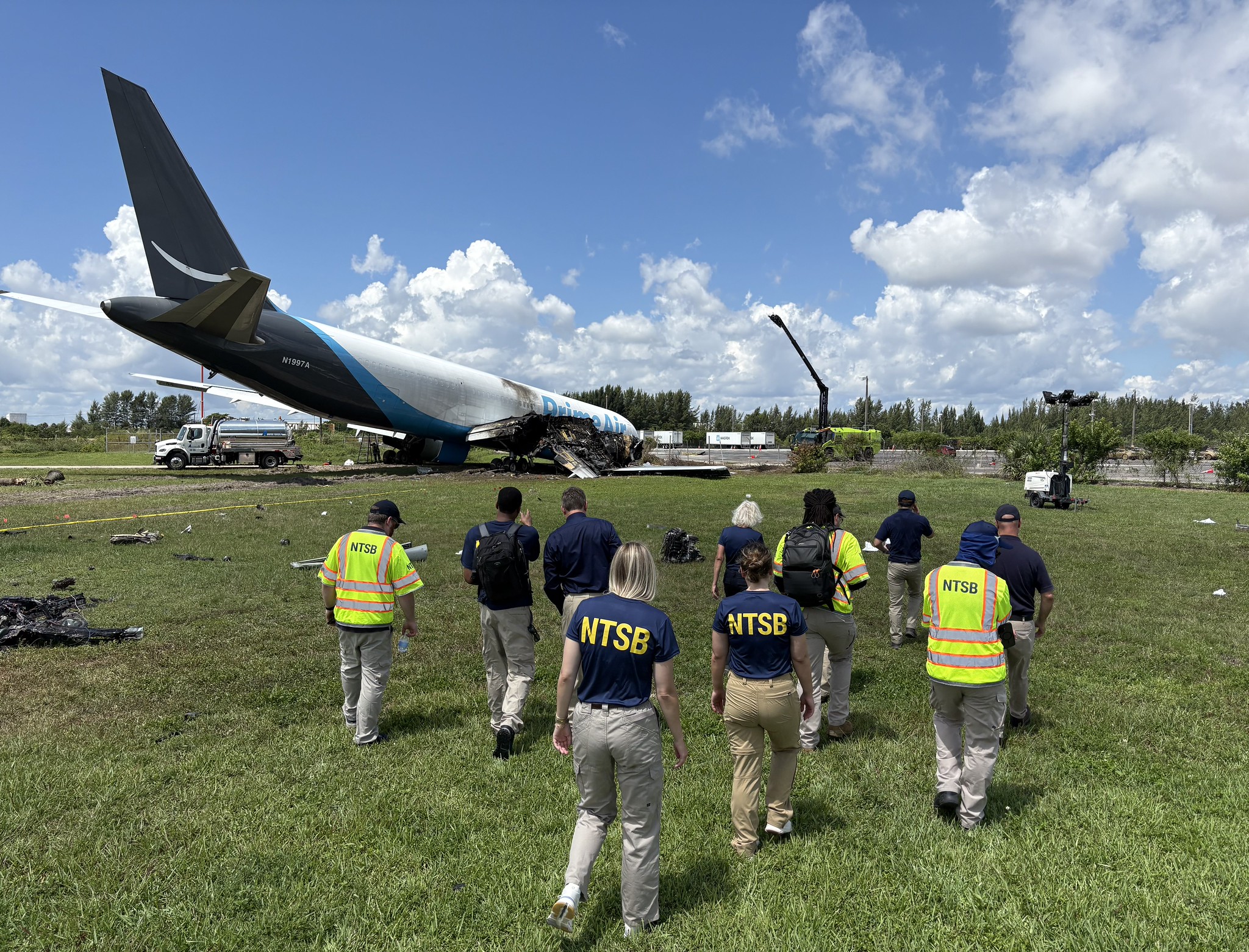

New flight recorder data from the Boeing 767 that overran Runway 30 at Miami International Airport Sunday shows the aircraft’s throttles advanced to values consistent with go-around thrust after touchdown. During a Tuesday evening briefing, NTSB investigators said the brakes were released before the increase in thrust, then reapplied four seconds later after the throttles returned to idle. The 21 Air freighter was operating an Amazon Prime Air flight from San Juan, Puerto Rico, when it overran the runway and struck two vehicles, killing five people on the ground.
Go-Around Thrust Recorded
The nose gear and right main landing gear touched down at a ground speed of 158 knots, according to flight recorder data. The crew began braking seven seconds later at 146 knots, and the left main gear touched down at 134 knots. Once at 120 knots, the brakes were released and throttles increased to values consistent with go-around thrust. Four seconds later, throttles were returned to idle and brakes were reapplied at 117 knots.
Investigator-in-charge Chihoon Shin said the recorded data showed no indication that the speed brakes or thrust reversers deployed. NTSB Chair Jennifer Homendy declined to characterize those findings before investigators complete an aircraft performance study.
“My career is over.” An unidentified pilot made the remark after escaping the aircraft, according to witness Abraham Altamar in an interview with CBS News. Altamar said the pilot was shaking and had injuries to his forehead and hand before borrowing a phone to call his wife.
CBS identified the pilots as Capt. Joseph Carroll, 55, and First Officer Jaime Felipe Silva Molina, 37, but said it could not determine which pilot spoke with Altamar. Both pilots were treated for injuries and later released.
Crew Interviews Underway
The captain received his Boeing 767 type rating in May and reported 7,145 flight hours on his March 2026 first-class medical application. The first officer received his 767 type rating in April 2025 and reported 2,655 hours on his August medical.
Homendy said investigators would compare updated information from crew interviews against company records. The cockpit voice recorder contains more than two hours of what the NTSB described as good-quality audio, while the flight data recorder contains about 55 hours of information covering more than 400 parameters.
Investigators said they wanted to interview the pilots before releasing a cockpit voice recorder readout.
Weather at the time of the accident included winds from 190 degrees at 17 knots, gusting to 26 knots. A thunderstorm was reported at the airport, along with 10 miles visibility and scattered cumulonimbus clouds at 2,000 feet.
The NTSB has not determined a cause of the accident and said a preliminary report is expected within several weeks of completing its on-scene work.


0 replies