
















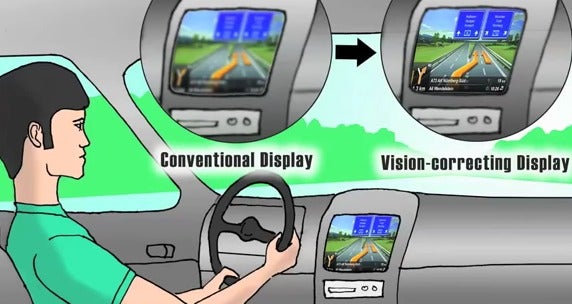
New display technology now in the research stages at the MIT Media Lab automatically corrects for vision defects, so users don’t need to wear glasses or contact lenses. “The technique could lead to dashboard-mounted GPS displays that far-sighted drivers can consult without putting their glasses on,” according to the MIT news release. The screen also could display 3-D content and diagnose the user’s vision defects. “So the same device could, in effect, determine the user’s prescription and automatically correct for it,” said MIT. Researchers at the University of California at Berkeley also are participating in the research.
The display is a variation on a glasses-free 3-D technology also developed at MIT. But while the 3-D display projects slightly different images to the viewer’s left and right eyes, the vision-correcting display projects slightly different images to different parts of the viewer’s pupil. “Essentially, the new display simulates an image at the correct focal distance — somewhere between the display and the viewer’s eye,” said MIT.

