
















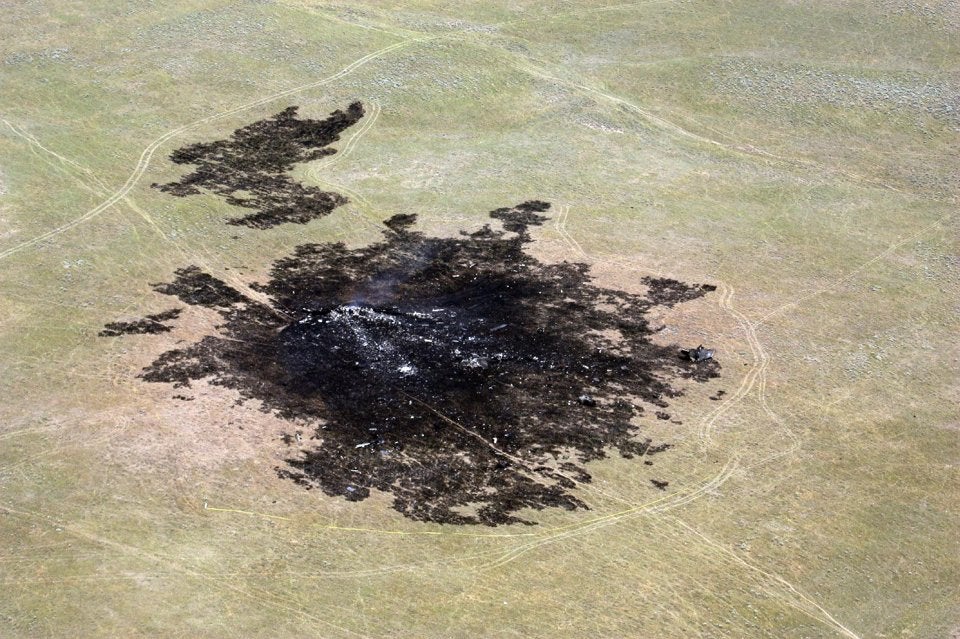
Witnesses who saw the crash of a B-1B Lancer Cold War-era swing-wing bomber in southeastern Montana Monday say it broke up in flight, RapidCityJournal.com reported Wednesday, but those accounts remain officially unconfirmed. Early reports are often unreliable; these state that witnesses described the jet coming apart and scattering debris across several miles. The bomber was flying a training route and crashed at about 9 a.m., roughly half an hour after departing from Ellsworth Air Force Base, South Dakota. One witness, rancher Braden Garwood, has said he heard an explosion and saw a mushroom cloud rise from the site while a large mass of flaming metal was still falling to the ground. When that piece hit, there was another mushroom cloud, he said. Officially, all four crewmen ejected safety without sustaining life-threatening injuries.
The main wreckage left a charred patch on a privately owned field. Air Force officials were accounting for and collecting debris early this week, with trucks, tankers and trailers on scene, a security checkpoint and five tents. The FAA restricted flight within 10 miles of the crash, with the exception of military aircraft. The Air Force is still working to determine the cause of the crash and, aside from early information about the crew, has not released much additional information regarding the event. In 2001, another B1 was lost when it crashed in the Indian Ocean. That wreckage was not recovered and no official cause of the crash was determined. The 1980s supersonic bomber can reach speeds of Mach 1.25, carrying nuclear weapons. Roughly 100 of the aircraft have been produced by Rockwell, and now roughly 60 remain in the U.S. Air Force’s fleet.

