
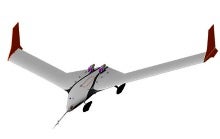
The U.S. Air Force is planning to fly a drone this summer to test technologies that will be needed for new kinds of lightweight supersonic aircraft with flexible wings, according to a news release from NASA. The drone itself, the X-56A, is subsonic, but the knowledge gained about flutter and gust suppression will be used in designing the proposed supersonic X-54, NASA said. The tests this summer will take place at NASA’s Dryden Flight Research Center in California. After the Air Force completes its tests, NASA plans to take over the X-56A for continued testing.
The X-56A is 7.5 feet long, with a 28-foot wingspan. It’s powered by two 52-pound-thrust JetCat P200-SX turbine engines. Its long, thin wings are susceptible to uncontrollable vibrations, or flutter, and can be stressed by bending forces from wind gusts and turbulence. The tests this summer aim to practice suppressing flutter by adjusting software programs in the aircraft’s flight computer. Researchers also will try to learn how to ease the gust loads, to make flexible aircraft safer in turbulence.