
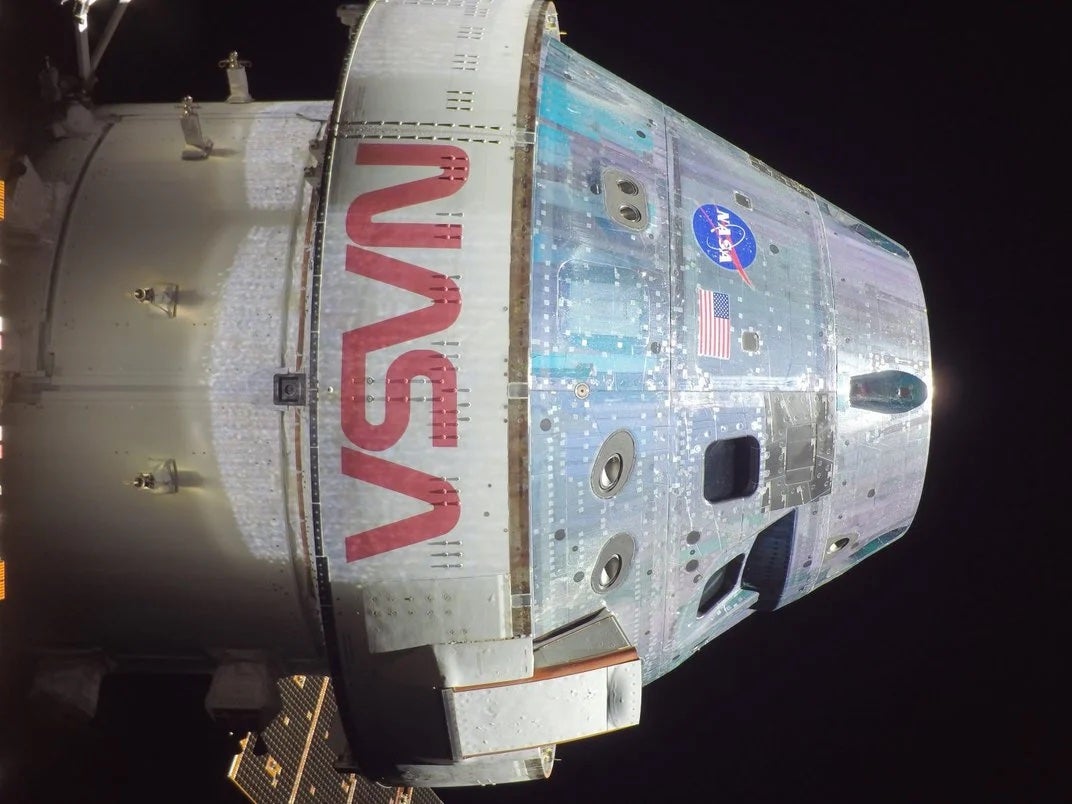

NASA’s Orion spacecraft, launched last Wednesday (Nov. 16) atop the Artemis 1 Space Launch System (SLS), sent back compelling images of the Earth and made a low pass over the dark-side surface of the moon on Monday. “Low” is relative, of course, but descending to within 81 miles of the moon’s surface yielded some breathtaking images. That distance contrasts with the 280,000 miles Artemis 1 had to travel to reach the closest point to the moon of its journey.
The mission is the first of three, with the ultimate goal of landing humans on the moon for the first time since Apollo 17 crew member Gene Cernan took the last lunar trek almost 50 years ago in December 1972. Artemis 2, currently scheduled for 2024, will retrace the path of the current mission, but with human occupants replacing the mannequins seated aboard Artemis 1. Artemis 3, optimistically targeted for 2025, is planned to land the first humans on the moon in more than half a century. What NASA learns from this exercise is meant to lead to the next stop, Mars.
With the long-range goal of the red planet in mind, the Artemis 1 mission is a 26-day exploration with a 1.3 million-mile itinerary. NASA says that’s farther than any other spacecraft (designed to carry humans) has boldly gone. Orion will enter a distant “retrograde orbit” (opposite to the direction the moon orbits the Earth) later this week and circle the moon for about a week before heading back home to Earth, executing a (hopefully) “precision” splashdown off the coast of Baja, California, on Dec. 11. Recovery teams from the U.S. Navy and NASA will be on site for the arrival.
As for the captivating pictures and video to be expected from NASA over the next few days, David Melendrez, imagery integration lead for the Orion Program, said in a statement, “Images captured during the [Artemis 1] mission will be different [from] what humanity saw during Apollo missions, but capturing milestone events such as Earthrise, Orion’s farthest distance from Earth and lunar flyby will be a high priority.”