















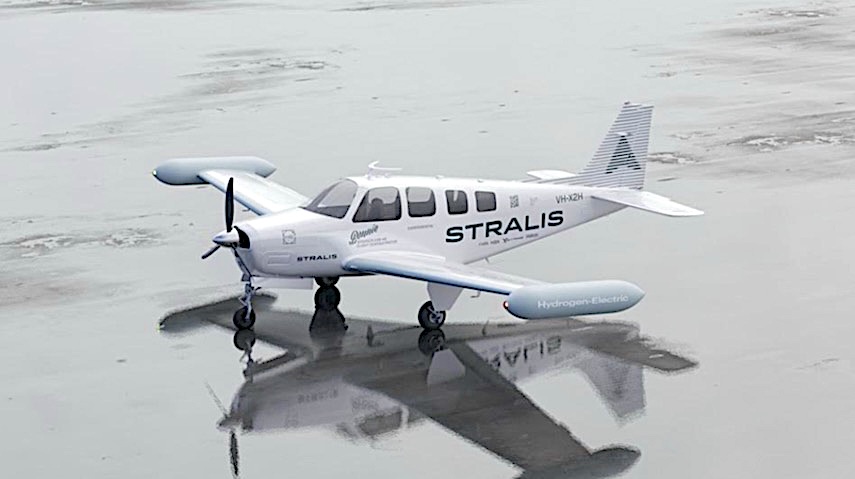

Aviate Enterprises, based in California, announced today it will be the U.S. launch customer for the first hydrogen-electric Beech Bonanza to fly in the U.S., to be designated Model A36-HE. The technology is currently in development by Australian startup Stralis Aircraft, which is testing the system on a pair of A-36s.
The system uses high-temperature PEM fuel cells, with significant weight reduction benefits, improved performance and reduced operating costs, compared with the Bonanza’s conventional piston engine. The hydrogen-electric system is also quieter and emission-free, with water vapor being the only by-product.
Stralis said ground testing and propeller spinning have been accomplished and the first flight is planned for late 2025 in Australia. Stralis co-founder and CEO Bob Criner said, “The Bonanza is an iconic and much-loved aircraft, and as 100LL fuel becomes increasingly challenging to access and owners face overhauls, now is an opportune time to begin the transition to a clean fuel and propulsion system.”
Timothy Devine, founder and President of Aviate Enterprises, Inc. said, “What we are doing is like 3 April 1973—the date of the first cellphone call made in the world. We are going to change the world of aviation with hydrogen fueled aircraft. Hydrogen is the most abundant element in the universe, and it is clean and green.”


DOA. Hindenburg. No range. Too heavy. Fossil Fuels are everywhere, are cheap, easy to store, and infinitely renewable. Read “Fossil Future” from Alex Epstein.
Hydrogen IS very abundant, but not in a free form. And it takes energy to separate it, process it, and compress it. The last is the issue - practicality demands storage as a gas, thus requiring very strong cylinders to contain it, with the obvious limited quantities. It is extremely difficult to manage as a liquid and, with present technology, impractical for transportation of this type. Each new technology has its inherent downfalls which may be overcome with future developments - but as they say, “we ain’t there yet!.”