














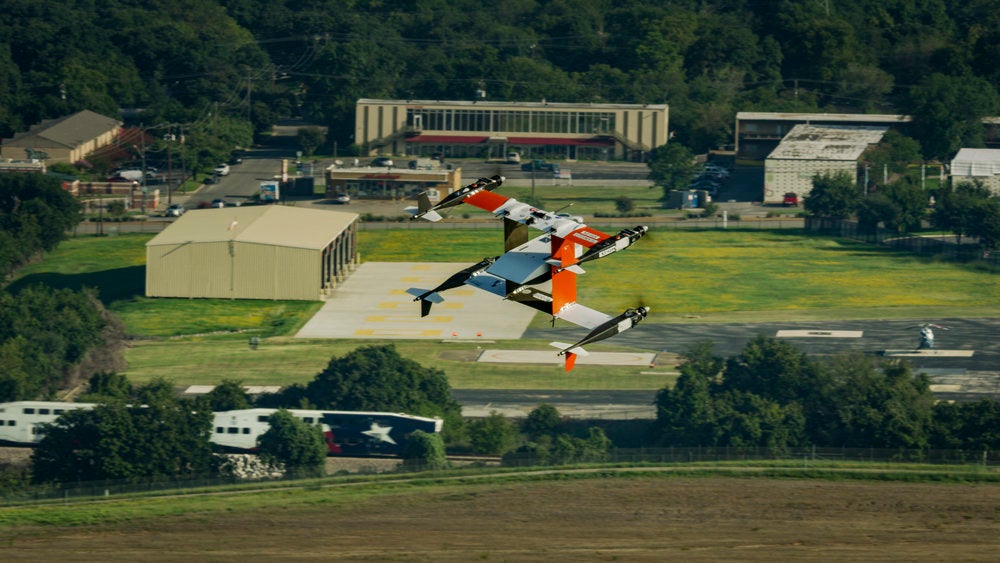

Bell Textron’s Autonomous Pod Transport (APT) 70 unmanned aircraft system (UAS/drone) successfully completed a demonstration flight on Monday as part of NASA’s Systems Integration and Operationalization (SIO) activities. The objective of the ATP 70 demonstration was to simulate an urgent medical transport mission including beyond visual line-of-sight (BVLOS) flight in an urban environment along with transitions into and out of Class B airspace. It was conducted in support of the SIO program’s goal to “work toward commercial UAS operations in the NAS [National Airspace System].”
“This demonstration is a step on the path toward certification of commercial UAS operations,” said NASA SIO technical manager Kurt Swieringa. “Services such as urgent medical supply transportation can be beneficial to the public and can highlight the positive use cases commercial UAS operations provide.”
For the demo, the ATP 70 departed from Bell’s Floyd Carlson Airfield facility in Fort Worth, Texas, and flew a preprogrammed 10-mile route along the Trinity River. According to Bell, data collected during the flight will be used to evaluate detect and avoid (DAA) and command and control (C2) technologies in support of future standards development and FAA certification guidelines. Bell’s partners for the demonstration included Xwing and the University of Massachusetts Amherst’s Center for Collaborative Adaptive Sensing of the Atmosphere (CASA).
The APT 70 is a vertical takeoff and landing (VTOL) design powered by an electric-hybrid propulsion system. It completed its first autonomous flight in August 2019 and its first BVLOS flight last July. The aircraft has a range of 35 miles, top speed of 100 knots and is capable of carrying payloads of up to 70 pounds.
