














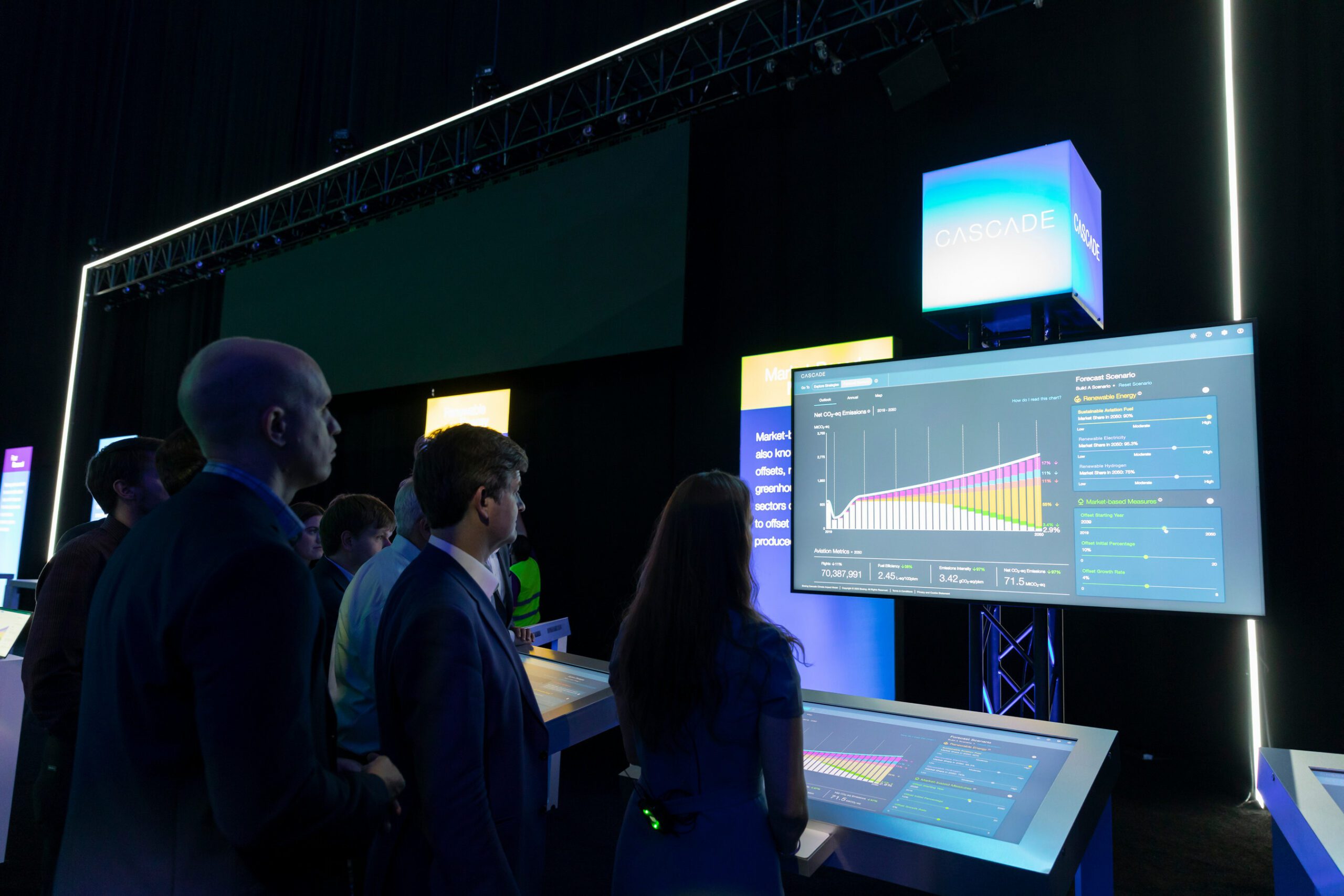

Boeing has publicly released a data modeling tool designed to identify the effects of sustainability solutions on aviation carbon emissions. Called the Boeing Cascade Climate Impact Model, the tool looks at “the full life cycle of alternate energy sources for aviation—from production through distribution and use—and quantifies the ability to cut aviation’s carbon emissions.” In addition, Cascade lets users model decarbonization strategies such as airplane fleet renewal, operational efficiency improvements, renewable energy sources, future aircraft and market-based measures.
“We created Cascade to serve as an industry tool that creates a common framework among aviation, energy, finance and policy,” said Boeing Chief Sustainability Officer Chris Raymond. “By putting data first and sharing this model with the public, we are enabling collaboration, feedback and alignment across industry, government and others who work together to achieve a more sustainable aerospace future.”
Among its key takeaways from Cascade assessments, Boeing found that sustainable aviation fuel (SAF) will probably be the biggest contributor to reducing carbon emissions given that it can be used in commercial aircraft models currently flying. As for new technologies, Cascade assessments suggested that emerging electric- and hydrogen-powered aircraft will likely provide only limited contributions to emissions reduction through 2050 “due to long timeframes for development and deployment and the magnitude of related infrastructure changes for airports and pipelines.” Alongside the modeling tool, Boeing introduced the Cascade User Community working group, which will offer feedback on new features, functions and application programming interfaces.
