














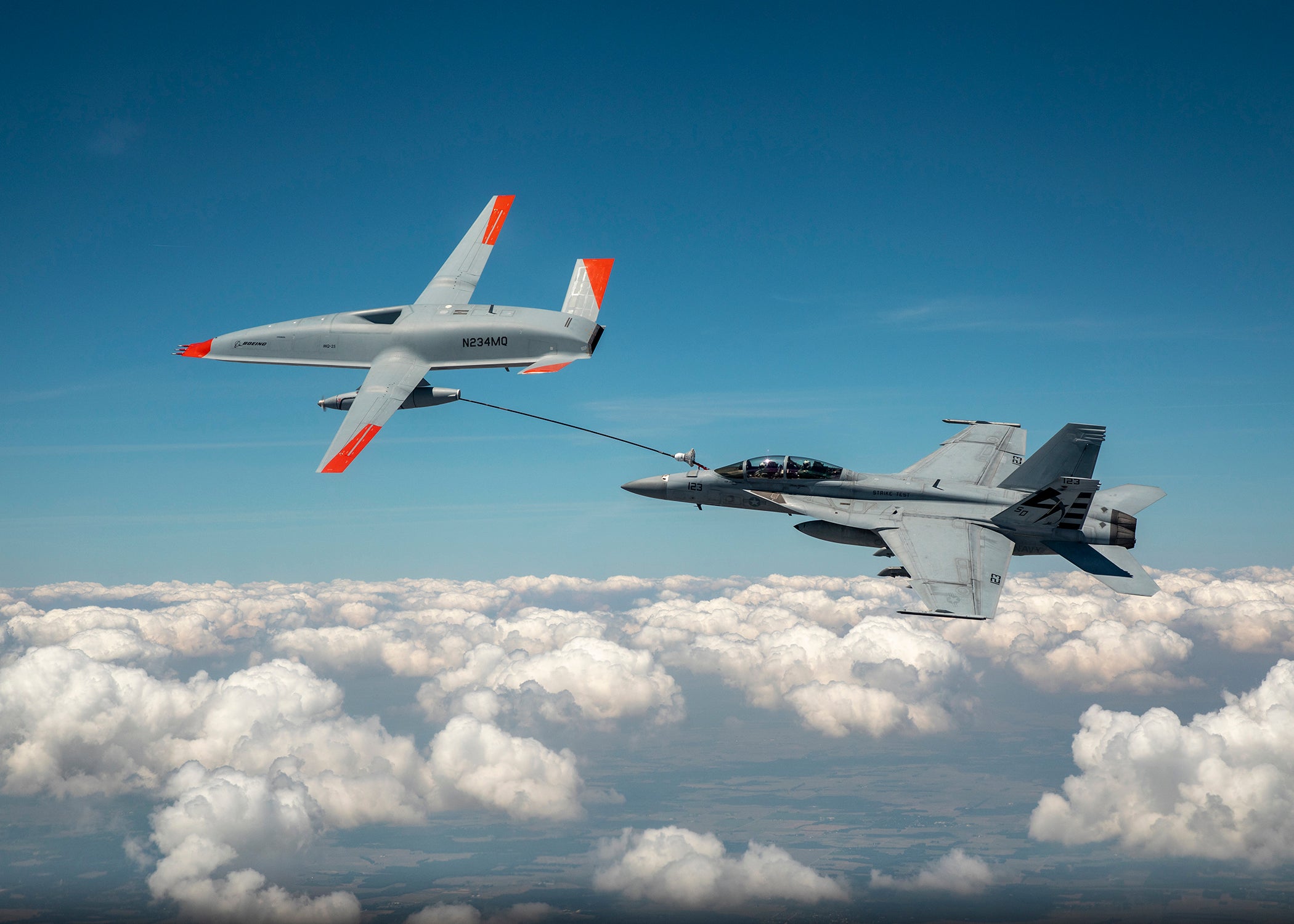

A team led by Boeing has completed a new demonstration of manned-unmanned teaming (MUM-T) capabilities. Conducted in a “virtual environment,” the demonstration used Northrop Grumman’s portable E-2D Advanced Hawkeye simulator along with Boeing’s F/A-18 Super Hornet and MQ-25 Stingray uncrewed aerial refueling drone simulations. According to Boeing, the mission scenarios demonstrated included the “E-2D successfully acting as the air wing ‘tanker king’ while the MQ-25 refueled the F/A-18, in addition to supervising the MQ-25 during an intelligence, surveillance and reconnaissance mission.”
“Two of our key findings from this early demonstration with existing data links are that initial MUM-T capability between MQ-25, E-2D and F/A-18 is achievable with minimal change to the crew vehicle interface and could be integrated into earlier MQ-25 operational deployments,” said Boeing MQ-25 advanced design leader Don “BD” Gaddis.
The demonstration was sponsored by the Office of Naval Research. Future MUM-T tests are expected to focus on additional mission areas, interface enhancements, autonomous behaviors and resilient, protected networks. MUM-T capability is listed as a primary goal in the U.S. Navy’s Unmanned Campaign Plan, which is aimed at integrating autonomous systems “to provide lethal, survivable, and scalable effects supporting the future maritime mission.”
