















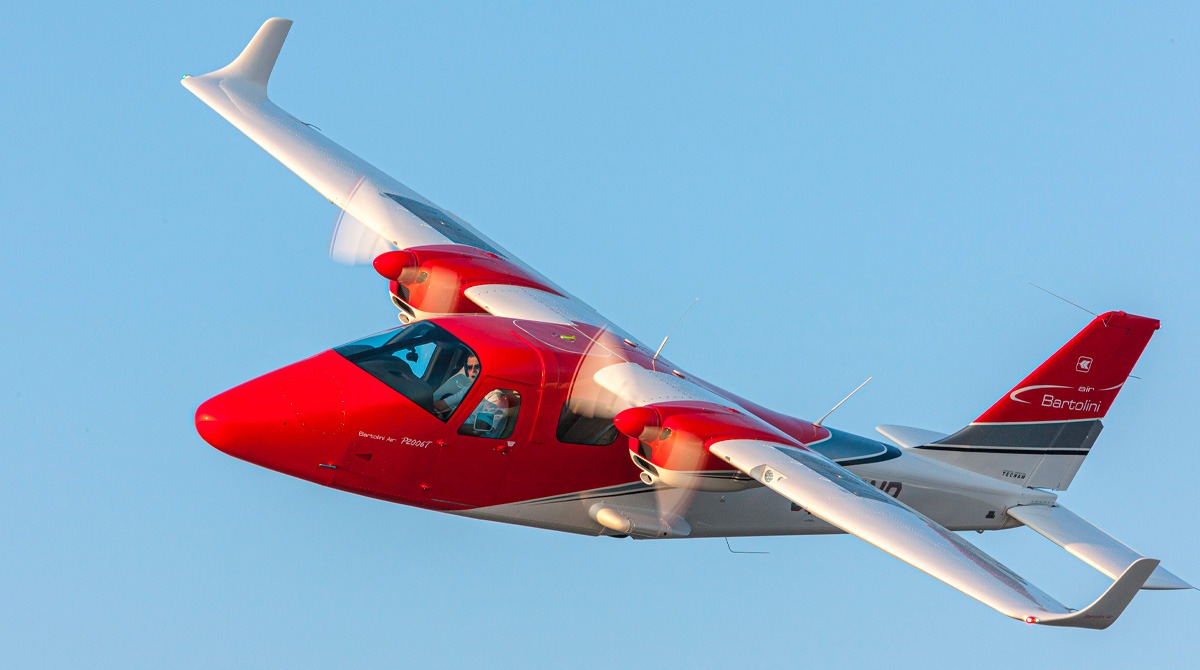

Last week the NTSB released its final report on a June 16, 2024 off-airport accident in Larkspur, Colorado. Both pilots were seriously injured and the Tecnam P2006T they were flying sustained substantial damage.
The main culprit? Carb ice.
During the flight, the pilots conducted one-engine-inoperative procedures with the left engine shut down. After two tries to restart the engine afterwards, the pilots got the engine going again and started their return journey back towards Centennial Airport (APA) in Englewood.
As they began descending near the airport, the MEI and CSEL pilots noticed they needed an increased amount of right rudder pressure in order to maintain control of the aircraft. While dealing with the battle to stay coordinated, the pair discovered drops in both left engine rpm and temperature.
Emergency Landing
As the left engine continued losing power, the instructor diverted toward Perry Park Airport (CO93), about four nautical miles away. After securing the left engine and feathering the propeller, the pilots realized they would not be able to make the runway and chose to instead attempt an emergency landing on southbound Interstate 25.
Witnesses captured video of the aircraft descending over the highway with its left propeller stopped and right propeller turning. The airplane’s left wing struck a road sign before veering left to avoid vehicles and coming to rest inverted in a marshy area east of the roadway.
Investigators found the carburetor heat levers in the OFF position and the left propeller lever retarded but not fully feathered. Functional tests on both Rotax 912S3 engines revealed no preimpact mechanical issues that would have prevented normal operation.
The NTSB noted that weather conditions at the time were conducive to the formation of serious carburetor icing at glide power settings.
“The flight instructor’s failure to apply carburetor heat resulted in a loss of left engine power due to carburetor icing,” the report stated as the probable cause.
Risks in Flight Training Context
Training flights are, unfortunately, inherently prone to experience-related risks. The 28-year-old MEI had about 1,174 hours under the belt, including 115 hours in the Tecnam the pair flew that day. Meanwhile, the 23-year-old pilot who was receiving instruction had about 1,084 total hours, only two of which were gained in that particular aircraft. This was their first multi-engine training flight together.
This was, of course, a training flight, but it is worth noting—as the report does—that, according to the aircraft flight manual, engine shutdowns for training should be avoided except when required by regulation. The manufacturer also cautions that repeated in-flight engine securing can cause long-term damage due to high propeller loads during restart.
The NTSB emphasized that proper use of carburetor heat—particularly during low-power operations—is critical to prevent icing.
NTSB Safety Reminder
Preventing Carburetor Icing (SA-029), published several years back by the NTSB, notes that serious carburetor ice can occur at temperatures as high as 90 degrees Fahrenheit and relative humidity as low as 35 percent.
As with just about any GA accident debrief, the root causes of this accident go back to basic concepts. Most of us, the pilots of this very flight included, surely know to think about applying carb heat in an equipped plane if we see engine roughness or dropping rpms or temperatures.
Yet in an actual emergency situation, that knowledge needs to be front of mind and second nature. It’s one of the many reasons that we pilots absolutely need to understand our systems on a deep level. Knowledge becomes second-nature far more easily when we understand not just “what” we need to do, but also the “why.”
It’s a good reminder for the rest of us to review our systems, to think through possible failures often and ahead of time, and to be ready to act if or when the time comes.
Be safe out there, follow your checklists, and don’t forget the carb heat.


Personally, not a big fan of the Rotax engine. To me its to “light weight”. It needs to be “burped” prior to start, takeoff RPM is like 5,800, cruse 5,500 RPM and needs a gearbox for the prop. Its “best” attribute is fuel economy. Give me a direct drive Lyc or Continental anytime.
Also get a lot of carb ice on Continentals. Carb heat is there for a reason.
Was there any information available about what type of fuel that was used? Rotax engine may operate on MOGAS, a fuel that does not give the same protection against carburettor icing as AVGAS.
A flight instructor did this? Did he also use the carburetor heat lever as a hat rack?
We fly Rotax 912 with dual carbs in our Tecnam P92s and Vans RV-12s–and there is no carb heat. We have had little problem with carb ice, however. IMHO it is because the carbs are on top of the engine. Amazing that the instructor was shutting down an engine–and that the aircraft would not fly on one engine. Sigh. At least they survived–but our insurance rates go up and up.