















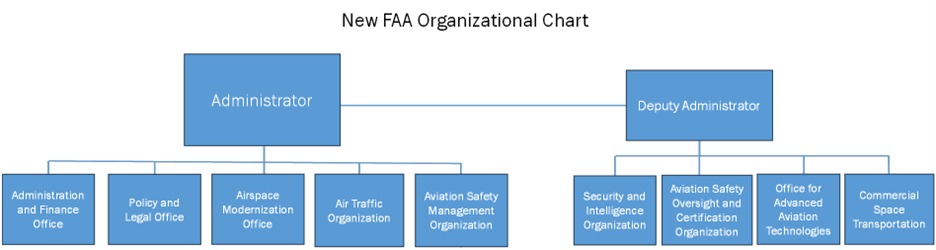

The U.S. Department of Transportation announced on Monday plans for the FAA to undergo what the department said will be the administration’s largest ever structural reorganization. According to Transportation Secretary Sean Duffy, the reorganization will look to improve safety oversight, advance airspace modernization, and integrate new aviation technologies.
The overhaul will include the formation of a centralized Aviation Safety Management System office that will unify safety processes previously divided among five separate units. An Airspace Modernization office focused on installing a new air traffic control system will also be created. Additionally, new resources for integrating drones, eVTOLs, and other Advanced Air Mobility vehicles into the National Airspace System will be available through an Advanced Aviation Technologies office.
According to the DOT, the new structure will support the implementation of Flight Plan 2026, the agency’s strategic blueprint focused on what the FAA calls the plan’s three pillars: people, safety and modernization of the National Airspace System.
The FAA will also consolidate internal functions, including finance, IT and human resources, under the Office of Administration and Finance to reduce redundancy and improve coordination.
“It’s important that we have the right people in the right places to do the best work possible,” FAA Administrator Bryan Bedford said. “These actions will put permanent leaders in place who embrace innovation, share safety data and insights freely and are focused on deploying a brand-new air traffic control system all while integrating key innovation technologies into the new National Airspace System.”
NBAA President Ed Bolen described the move as “a bold plan for a new era in aerospace.”
“The FAA’s new structure makes the changes required to increase operational efficiency, foster innovation and empower the bold action needed to build an aviation system that in many ways will redefine air transportation,” Bolen said.


Reorganization is a tried and true way to give the appearance of progress while not actually solving a problem. I went through many of them over the 23 years that I worked in the federal government. What really does work is putting the right people in positions of authority - people who are experienced in their jobs and know what they are doing. I don’t see many signs of that happening in our current administration. Another thing that really works is putting as much authority and responsibility for accomplishing a project in a single chain of command at the lowest level. Large government organizations tend to distribute authority and responsibility for accomplishing new projects across multiple organizational segments, which raises the level at which coordination and oversight must occur to accomplish a major project.Then the leaders of the organization who are responsible for that coordination and oversight are chosen based on political affiliation rather than competence. Or else there are changes in top leadership that cause changes in the project as they trickle down the organization, either because the project fails or goes over budget and schedule. Some projects take years to accomplish and don’t survive a 4-year political cycle or 1-year budget cycle.
Wise words or experience here. If you know, you know.