















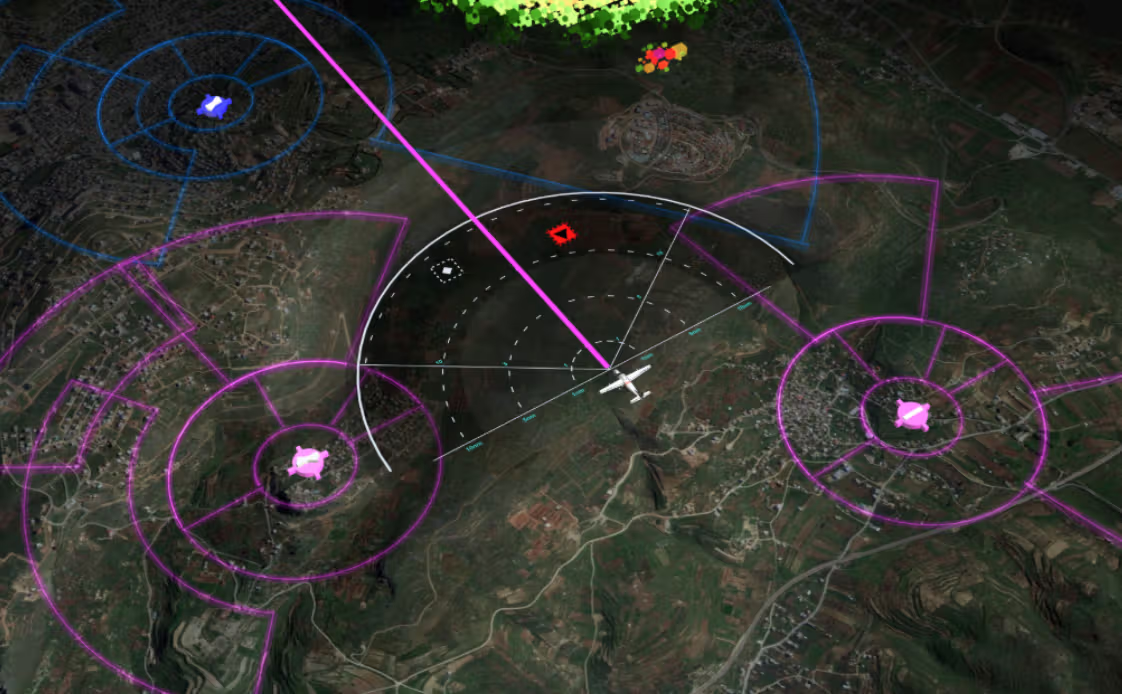

Reliable Robotics said it has wrapped up FAA flight testing of new uncrewed aircraft detect-and-avoid (DAA) technology in and around airport environments. The work was conducted under the FAA’s Broad Agency Announcement program and is intended to support certification and technical standards for larger uncrewed aircraft systems operating in the National Airspace System. The company said the testing was carried out in collaboration with Virginia Tech’s Mid Atlantic Aviation Partnership, with support from Sagetech, Collins and uAvionix. The campaign focused on terminal-area and traffic-pattern operations, where uncrewed aircraft would be expected to maintain separation and operate alongside existing traffic.
Reliable said its DAA system is built around the FAA-developed Airborne Collision Avoidance System X, or ACAS X, and is intended to support remote pilots’ responsibility to remain well clear of other traffic and avoid collisions. The FAA-contracted flights evaluated how the system performed near the boundary between en route and terminal environments around airports, and whether it could provide appropriate alerts and maneuver guidance for remote pilots in those settings.
“Demonstrating the ability of UAS to integrate into airport environments with a VFR traffic pattern is necessary for building a scalable aviation autonomy solution,” Brandon Suarez, Reliable Robotics vice president of UAS integration, said.
Suarez added that the data collected under the FAA effort is “tremendously useful in the development of relevant and useful standards.”
The company said a key result from the test campaign was further validation of how ACAS X behavior changes between en route and terminal airspaces. To complete the contract, Reliable said it conducted hardware-in-the-loop testing and a series of scripted flight encounters around Hollister Municipal Airport in California.
Sagetech Chief Technology Officer Matthew Hamilton said the tests were important for the safety of UAS in the national airspace.
“Real-world testing advances the substantiation of standards that we rely on to build DAA solutions that keep our skies safe,” Hamilton said.
The company said data from the flights has been provided to RTCA Special Committees 228 and 147, part of an industry standards organization that works with the FAA on technical guidance for aviation systems. According to Reliable Robotics, the information will be used to help shape future standards for detect-and-avoid and collision-avoidance technology.


0 replies