

















Update:
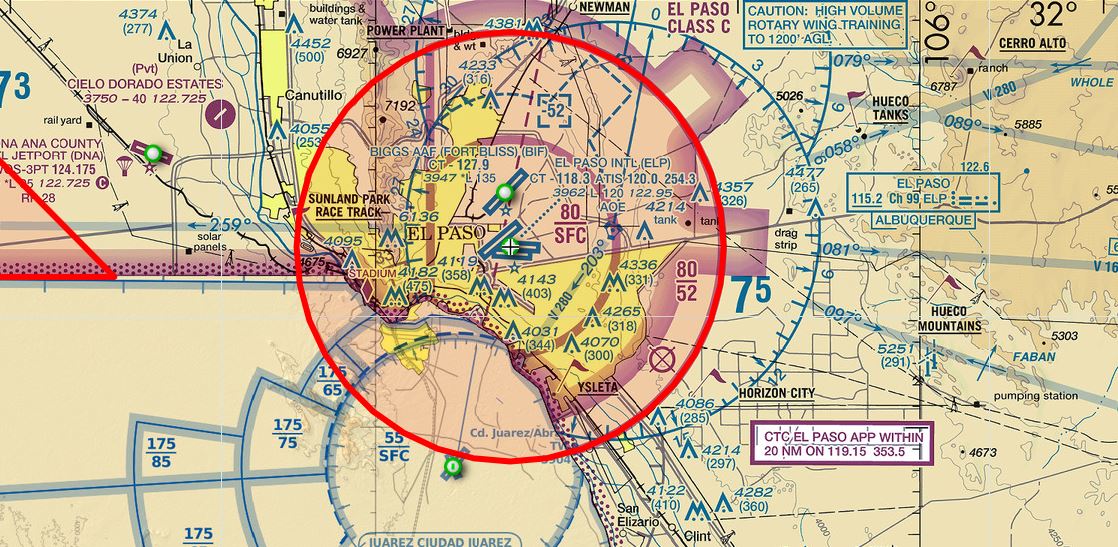
A brief airspace shutdown in El Paso ended abruptly Wednesday morning. Although originally designated as a 10-day shutdown of the airspace surrounding El Paso International Airport (KELP), the closure ended after only a few hours.
According to reporting from the New York Times, a source said the airspace closure was linked to ongoing testing of new counter-drone technologies at nearby Fort Bliss.
Department of Transportation Secretary Sean Duffy wrote on social media shortly after the closure was lifted that that the closure was made “to address a cartel drone incursion.”
The FAA and DOW acted swiftly to address a cartel drone incursion.
— Secretary Sean Duffy (@SecDuffy) February 11, 2026
The threat has been neutralized, and there is no danger to commercial travel in the region.
The restrictions have been lifted and normal flights are resuming. https://t.co/xQA1cMy7l0
Original:
The Federal Aviation Administration (FAA) has ordered a 10-day shutdown of the airspace surrounding El Paso International Airport (KELP), effectively halting all commercial, cargo, and general aviation traffic through late Feb. 20.
According to the Associated Press, a notice posted on the agency’s website cites “special security reasons” for the temporary flight restrictions (TFRs), but offers no additional explanation. The closure applies only to U.S. airspace and does not extend across the border into Mexico.
The FAA said the area has been designated “national defense airspace,” warning that the government may use deadly force against any aircraft determined to pose an imminent security threat.
Airport officials are awaiting further direction from the FAA and are notifying affected carriers. El Paso normally handles roughly 55 departures per day, with service provided primarily by Southwest, American and United, along with other major airlines.


What is concerning here is what the government might deem to be an “imminent security threat,” and what the consequences are for civil aircraft. There is certainly agreement that a hijacked aircraft which will be used as a weapon is an imminent security threat. However, I believe it was Peru which got universal condemnation when they announced they would shoot down aircraft suspected of narco-trafficking.
What is concerning, however, is how the government defines an imminent security threat, and what the consequences might be for civil aircraft. There is broad agreement that a hijacked aircraft being used as a weapon clearly constitutes such a threat. However, history has shown the dangers of expanding this interpretation—Peru, for example, faced universal condemnation when it announced it would shoot down aircraft merely suspected of narcotics trafficking.
The ICAO position on this issue is unambiguous. It is codified in Article 3 bis of the Convention on International Civil Aviation (Chicago Convention), which explicitly states:
“States shall refrain from resorting to the use of weapons against civil aircraft in flight.”
This principle is rooted in elementary considerations of humanity and customary international law. ICAO emphasizes that the use of weapons against civil aircraft is fundamentally incompatible with international aviation norms and humanitarian principles.
It was an attack of party balloons. How embarrassing…
Much contradictory information reported, some of it clearly not logical.
Why 10 days solid shutdown?
Trump bunch no better than sensationalist mass media types.
(Note an innocent looking balloon could be used to smuggle things, conceivably could have been deliberately launched as part of military test of counter-drone tactics.)
The story kept changing by the hour yesterday. From what was reported in the Washington Post:
The DHS said they’re going to deploy laser technology in the area to counter Mexican drones. Talks with the FAA to work out the impact and risk to civil aviation were scheduled for Feb 20. Recent laws forced into a Defense authorization bill by the White House that permit the Pentagon to act recklessly in public airspace already had the FAA on edge, so when Hegseth transferred the laser to the DHS earlier than planned and the latter used it—to surprise take down a mylar balloon—the FAA didn’t wait around to see if DHS could “surprise” the Mexican drones, or a civilian airplane, they shut down all civil aviation for the 10 days between Feb 10 and Feb 20, after which they would have a better idea as to how to protect the flying public from trigger-happy Hegseth and DHS. Apparently communications between Hegseth and the FAA have been strained since the Potomac accident a year ago. Also Hegseth is reluctant to give the FAA notice of any DoD activity that may impact civil aviation.
Today’s story says the DHS wanted to practice drone shooting with the laser so the airspace was shut down—for 10 days. I don’t buy it.
Reminder of what can happen when military activity is conducted in the midst of civilian air traffic…
In 2014 a Russian missile “surprised” a Ukrainian bomber at 33,000 ft. that turned out to be Malaysian Airlines Flight 17, a Boeing 777 transiting Ukraine airspace, killing all on board: 283 passengers and 15 crew.
Drones shooting down drones appears to be world wide phenomena recently and on going; especially in Ukraine. And not in small numbers. Attacks appear to happen in large number of drones; 1000 or more; insuring at least some get through with their bombs. Ugly, ugly, ugly. And dangerous.
Information in US military shot down balloon near El Paso after drone concerns | Fox News.
Claims:
Mexico’s president says Mexico knows nothing about the operation, sticks it to Trump by saying communication and cooperation are proper way to operate.
Hmm - airspace closure for safety of legitimate operators is good practice.
Did someone think cartels would just wait out short closures?
Article Airspace closure followed spat over drone-related tests and party balloon shoot-down, sources say - CBS News claims DHS and FAA did not agree. A US base is adjacent to El Paso civilian airport.
Your government lying to you again.
Cartels seem to be the go-to reason these days.
Didn’t the president of Mexico suddenly acquiesce on something around this timeframe? - I guess we found a way to avoid that pesky Oops!, accidentally shot down the Mexican president’s plane. - I hear there’s a similar precedent from another nearby brown-skinned country. I think they both have oil..?