















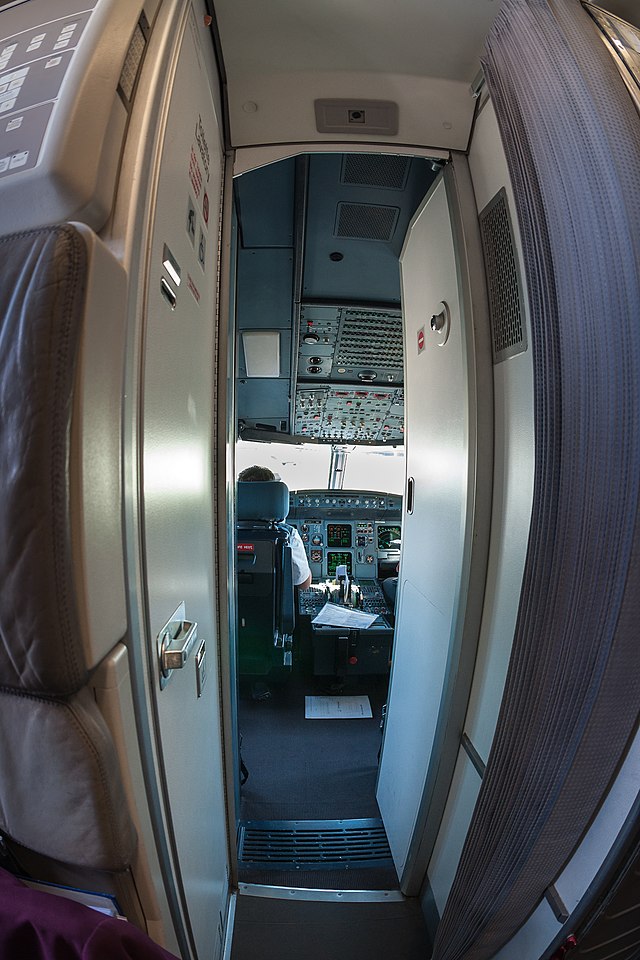

The Federal Aviation Administration has pushed back the deadline for U.S. airlines to install secondary cockpit barriers by one year, the agency announced this week.
The rule, introduced in 2023, mandates that new commercial aircraft include an additional physical barrier to secure the flight deck when the cockpit door is open. It was originally slated to take effect in August 2025, but now has a 2026 compliance deadline, according to a Reuters report.
Airlines for America—the trade group representing major carriers including American Airlines, United Airlines and Delta Air Lines—has requested a two-year postponement, citing several critical implementation challenges, including that the FAA has not yet certified any secondary cockpit barrier designs, and no associated manuals, procedures or training programs have been authorized.
“This will allow time to facilitate FAA certification and install the barriers,” the agency stated in its announcement of the revised timeline.
Meanwhile, the Air Line Pilots Association (ALPA) has strongly opposed the delay, urging the FAA last month “to reject this latest stalling tactic.” The union advocates for the prompt installation of what they describe as “lightweight, retractable security gates” to enhance pilot protection.
The union has been a vocal proponent of the rule, pointing to statistics showing at least 52 hijacking attempts worldwide since 2001, Reuters noted.
The yearlong extension is a compromise between immediate implementation and the longer delay requested by airlines.


A kind of safety net that is deployed before the cockpit door is opened would already be enough to significantly reduce the risk of an attack. The cockpit crew would still be able to look toward the cabin, but they couldn’t be directly attacked from behind it. It would be a simple and relatively inexpensive solution—almost like a fly curtain laughs.
There is no logical reason to have a passenger washroom immediately adjacent to the cockpit door.
Put another solid door between that washroom and the galley.
Use the same doors as presently used for the cockpit; a proven available product.
No passengers allowed in the forward galley.
This solution covers the greater majority of airline aircraft.
Get it done;
Now!
Brian Hope:
You are assuming a certain geometry of interior.
Original 737 has lavatory left front, handy for crew (pilots and F/As), galley opposite (with F/A working space aft of it).