
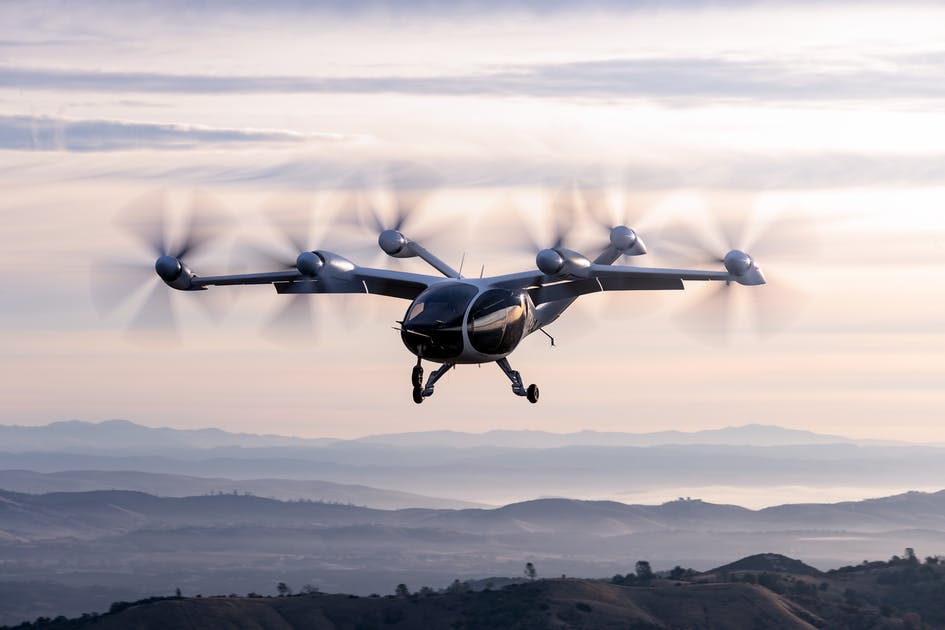

There’s nothing like an accident to seriously challenge the development program of any new aircraft. Piled on top of severe skepticism for all manner of electronically powered unmanned aircraft systems (UAS), the crash of California-based Joby Aviation’s prototype adds exponential attention to the cause of the mishap. Is that fair? Or is this the equivalent of pooh-poohing the invention of the wheel because the first examples yielded a bumpy ride?
Joby would contend that its performance targets, announced in late January, were ambitious, to say the least. They included a top speed of around 175 knots and a cruise altitude of at least 10,000 feet. Joby announced in January it had achieved its goal for speed—and the altitude target was bull’s-eyed on Feb. 1.
But two weeks later, after achieving speeds of 244 knots, the aircraft crashed (as it was unmanned, there were, of course, no injuries). To date, Joby has maintained it is not at liberty to discuss the accident any further, and the NTSB final report is 12 to 18 months away. With type certification scheduled for next year and entry-into-service pegged for 2024, how will the accident affect that timetable?
Walter Desrosier, vice president of engineering and maintenance at the General Aviation Manufacturers Association (GAMA), said, “For any accident, we need to know if it was due to a potential design issue, an operational issue or something else. Once the contributing causes are determined, then we move on to how to address them. Does it come back to changing the design? If so, will certification requirements need to be revisited in terms of how the updated design meets requirements?”
Joby has what is described as a second, identical prototype and is preparing to resume test flights.
Desrosier continued, “Test flights by definition are higher risk as they involve brand new design. And with eVTOLs, it’s a whole new type of aircraft, so there are a lot of unknowns.”