
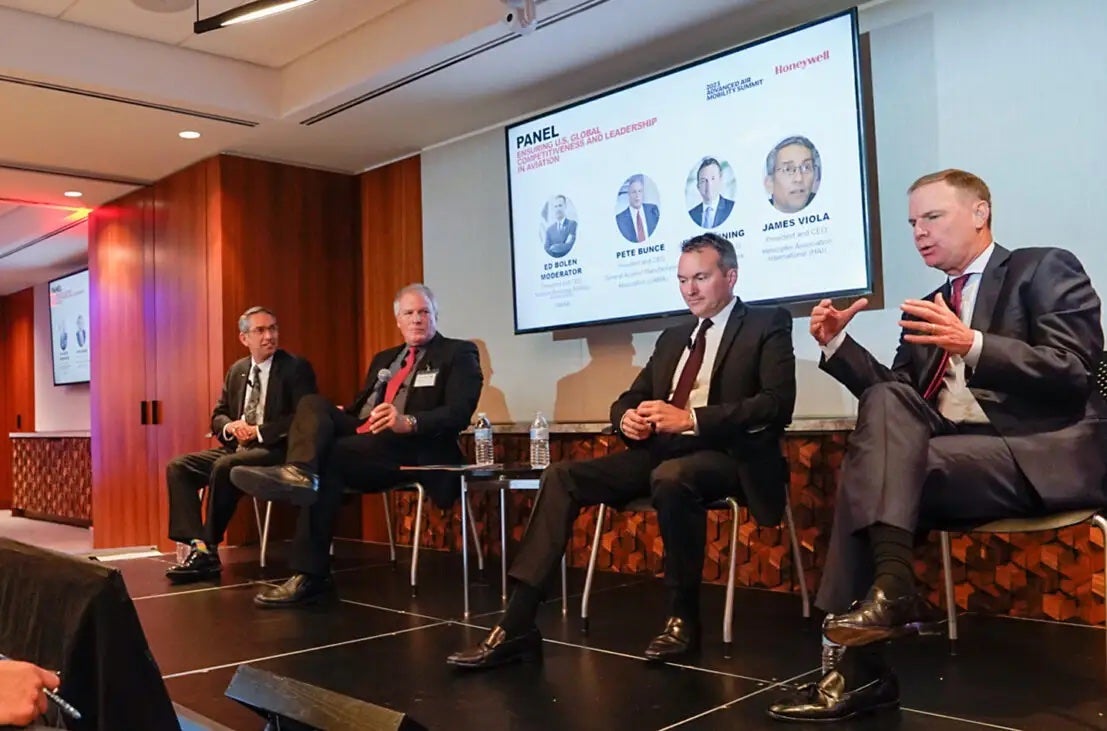

The National Business Aviation Association (NBAA) hosted a panel discussion in Washington, D.C., on July 18 during Honeywell’s second annual Advanced Air Mobility (AAM) Summit.
The goal of the panel was “to ensure the U.S. maintains its position as a global aerospace leader as AAM becomes a reality.” To do so, “government and industry need to work together and bypass bureaucracy to keep our competitive advantage,” according to the panel.
Moderated by NBAA President and CEO Ed Bolen, the panel also included Pete Bunce, president and CEO of the General Aviation Manufacturers Association (GAMA); Eric Fanning, president and CEO of the Aerospace Industry Association (AIA); and James Viola, president and CEO of the Helicopter Association International (HAI).
According to Archer Aviation CEO Adam Goldstein, who opened the summit, “Morgan Stanley predicts AAM will be a $6 billion market by 2035 and a $1 trillion market by 2040. These vehicles are really designed for everyone, not just a select group.”
Regarding the role of government in supporting and stimulating AAM, GAMA’s Bunce said, “The FAA has made commitments to get these aircraft in the air in 2025. But beyond that, we need the federal government to think long-term about how this new mode of transportation is going to move people from rural cities to the hubs, how we’re going to be able to get the airspace around metropolitan areas to be able to function when we take these out of the crawl, walk, run phase.”
Bolen summarized, “The benefits of AAM create a national imperative to get it done. We have an opportunity to have American leadership in an industry that’s going to have a profound impact for the future.”