















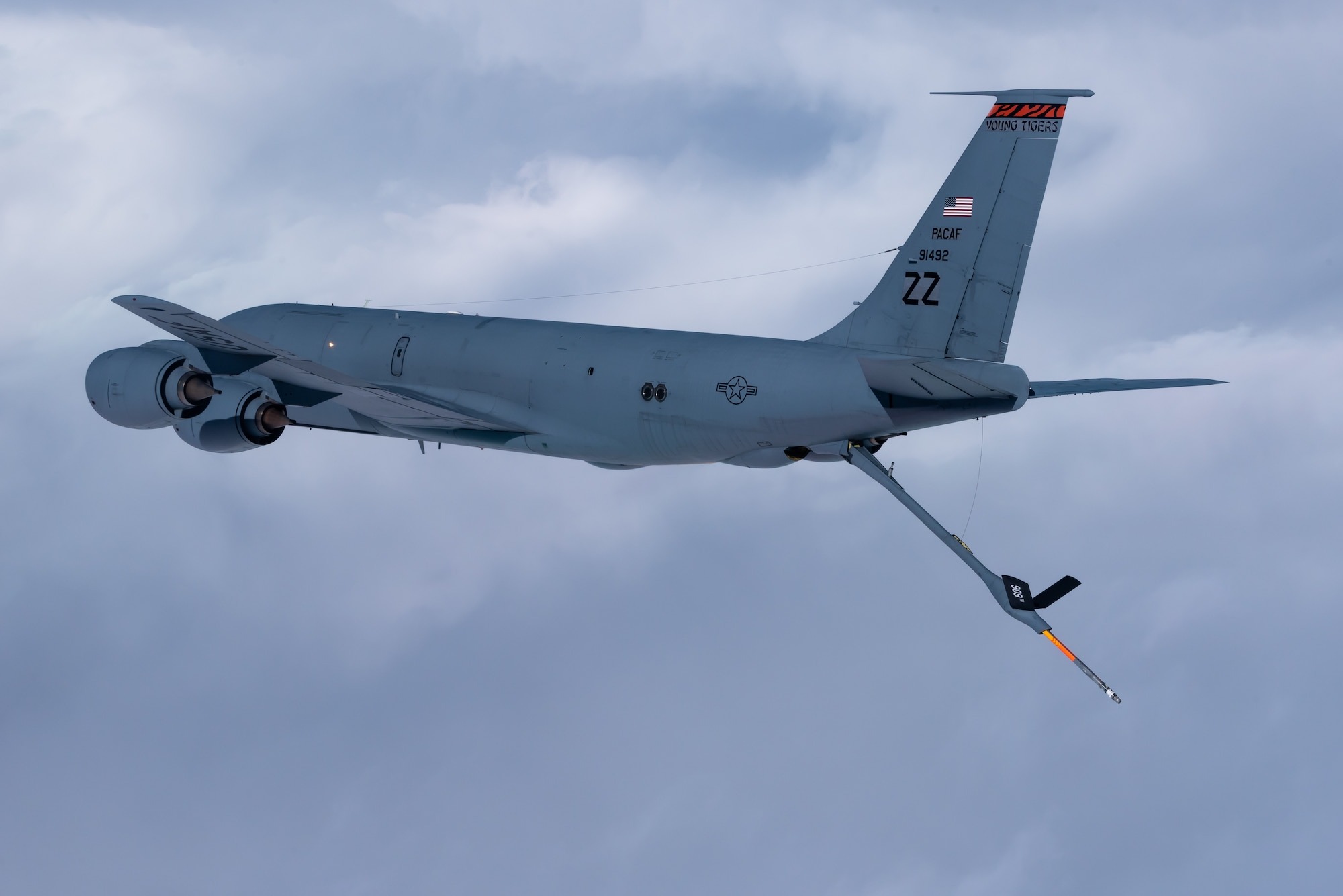

A U.S. Air Force KC-135 Stratotanker refueling aircraft crashed in western Iraq on Thursday during a combat mission, killing all six crew members on board, according to U.S. Central Command. The aircraft was involved in an incident with another plane while operating in what the military described as “friendly airspace,” and the second aircraft landed safely. Central Command said rescue and recovery efforts remain underway while the circumstances surrounding the crash are being investigated.
The tanker was supporting U.S. operations connected to the ongoing conflict involving Iran at the time of the incident. Gen. Dan Caine, chairman of the Joint Chiefs of Staff, said the aircraft crashed “while the crew was on a combat mission,” according to the BBC. Central Command said the aircraft’s loss was “not due to hostile or friendly fire,” the Associated Press reported, and the identities of the crew members are being withheld pending notification of their families.
The KC-135 Stratotanker, based on the Boeing 707 airframe, has served for more than six decades as the backbone of the U.S. military’s aerial refueling fleet, enabling aircraft to extend range and remain on station longer during missions. The aircraft typically operates with a crew that includes pilots and a boom operator responsible for controlling the refueling arm used to transfer fuel to other aircraft in flight. The Air Force is gradually introducing the newer KC-46A Pegasus tanker as part of a long-term replacement plan for the aging KC-135 fleet.


I’m reading various news posts stating that the “other aircraft” was another KC-135 that landed safely in Tel Aviv, albeit with half of its vertical stabilizer sheared off. Is it common for two or more tankers to fly in close proximity?
Do KC-135s transfer fuel between tankers? Is that capability there?
Probably.
Extends time on station.
(Or range, such as the wild case of British forces bombing the Falkland Islands.
In that show-flag exercise short-range tankers refuelled others, returned to Ascension Island to reload, then met the others coming back to give them fuel. All to support one Vulcan reaching its target. The Vulcan has short range, built to carry nuclear bomb into Russia. The Falklands mission launched two Vulcans with anti-missile equipment scabbed onto tail, the most serviceable proceeded to the target.)
Heavy bombers have range but I note that B-2s departed the US to bomb Iran as the UK denied use of Diego Garcia base in the Indian Ocean this year. (IIRC last year some B-2s hit Iran from the west, those departing Diego Garcia were a feint.)
The KC-10 tankers were purchased to support heavy bombers but they were retired.
Serious logistics work not often recognized.
Beware news media may not understand how many crew would be on board.
KC-135s had a ‘Flight Engineer’ operating airplane systems from a side panel behind the F/O position, with a seat there. Just like 707 and 727 airliners.
I suggest on long missions a spare pilot might be carried, perhaps classified information though Israeli fighter pilots and USAF B-2 crews have ways to handle long missions.
I doubt the KC-135R was converted to two-crew operation, i.e. removing the FE position, though UPS converted some B727 and/or DC-8 airplanes. (The MD-11 has only two flight crew, its close predecessor the DC-10 has three.)
BTW, current fleet are KC-135R as retrofitted with CFM-56 engines like second-generation B737s have, giving much greater range or much more fuel offload capacity.
And glass cockpits to get avionics capability to interact in civilian airspace.
KC-135s never had a flight engineer. The station behind the right side pilot was a navigator’s station. Navigators were phased out when no longer needed with the installation of INS and GPS navigation systems. The crew of a KC-135 is two pilots and a boom operator. The KC-135 involved in the collision that was able to land at Tel Aviv was assigned to the Air Force Reserve unit at Beale Air Force Base in northern California (from which I retired years ago). It did not have half its tail missing, only the upper third, this is an important fact because with only the top third gone, it still had its rudder! The KC-135 that crashed had two crews on board, four pilots and two boom operators.
Only a very few, if any still in use, KC-135s are configured to receive fuel in the air, the mission of a KC-135 is to “pass gas”, not receive fuel. At this point is is believed the collision was more like a head on collision.