















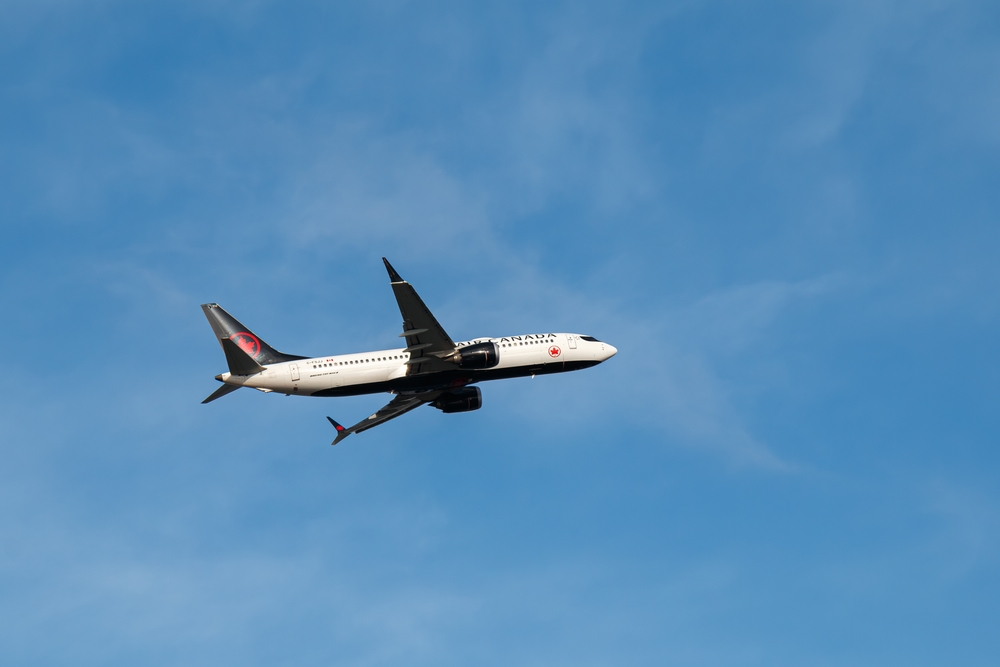

A Boeing 737 cruising at 34,000 feet over northern Wisconsin was targeted by a laser Sunday, according to the Lincoln County Sheriff’s Office. Minneapolis air traffic control notified local authorities after the crew reported the beam near County Highway E and Wadell Road in the Town of Bradley. Deputies contacted property owners but were unable to identify a suspect, according to the sheriff’s weekly report carried by Bluejay Radio. The aircraft reported no disruption to the flight.
Flight Data Points to Air Canada
Archived ADS-B data indicates the aircraft may have been Air Canada Flight 1275, a Boeing 737 MAX 8 traveling from Montreal-Trudeau International Airport to Harry Reid International Airport in Las Vegas. The aircraft passed approximately four miles southeast of the reported laser location at about 9:25 p.m. CDT while cruising at 34,000 feet. Air Canada, the FAA and the sheriff’s office have not publicly confirmed that AC1275 was the flight involved.
FAA Tracks Thousands of Strikes
Pilots reported 10,994 laser strikes to the FAA in 2025, a 14% decrease from the previous year. The agency has recorded 337 reported pilot injuries since it began tracking laser strikes in 2010.
“Laser strikes are decreasing, thanks to a strong pilot reporting culture that is providing the data we need for community engagement and work with local law enforcement,” FAA Associate Administrator Ben Supko said in a February FAA release. “But even one laser strike is too many when pilots have hundreds of lives in their hands.”


Just some MAGA moron trying to impress his Canada-demonizing cult leader who keeps insulting our closest and best ally with statements like “ Canada has been ripping us off and taking advantage of us for a long time” and “Canada needs us, we don’t need them” and “I’m gonna make them our 51st state because they want me to “. Turns out he was too busy applauding when forklifts rammed into the Kennedy Center columns to notice the laser attack tribute. “ I will demolish it if you don’t let me put my name back on it.” Your child-President really said that boys, girls, and MAGAts.
Oh, so you know who did it then? Thanks in advance for forwarding their information to the authorities!
Oh wait you don’t? You’re just spewing unrelated political dribble all over an aviation post that has nothing to do with politics?
It’s because it was “likely” a Canadian airplane, isn’t it? Ah i see.
I think you should give Reddit a try, they seem to enjoy this sort of ranting and raving. Leave this forum for people who actually want to discuss aviation.
Are you a retard or just a severe case of TDS? serious question. You know ,why don’t you mix up a batch of Jim Jones Kool aid, it will cure all your problems within minutes, and would be good for the world you pathetic worthless human.
Ya right, like from 34000’ they could guess that was the area…
Must have been pointing straight up and they flew right over it.
Sigh - scuum everywhere, local police need well equipped helicopter to pinpoint laser, it has been done when targeted by laser, pilots directed ground force to location and nabbed the bleep.
I hope the trash posting in this thread are not pilots, mechanics, dispatchers, … Dangerous mentality.
Interesting. I wonder if the crew actually had some way to actually provide that precise of an estimate of the location. Also, how could the person holding the laser focus it on the cockpit window of a plane at FL340. This may be fake news.
How can you even see the cockpit windows from the ground, that’s physically impossible. the cockpit is above the centerline of the fuselage.
Some people are so wrapped up with TDS they invent problems that don’t exist. It seems the new DSA organization is pulling out all the stops. They need so much mental health help I don’t think there are enough professionals
in the world to help them.
Presumably at an angle from the ground,
Another deranged person suffering from TDS trying to make literally everything political… TDS really is a mental illness.
It’s hard to imagine a more ignorant response to this serious article. Aside from the completely unjustified assumption about who was responsible, there is no way for someone on the ground to know what airline owns a jet flying over seven miles above him. As dangerous as these laser hits are, they are far more often stupid teenager tricks than malicious, and probably almost never political statements.