
















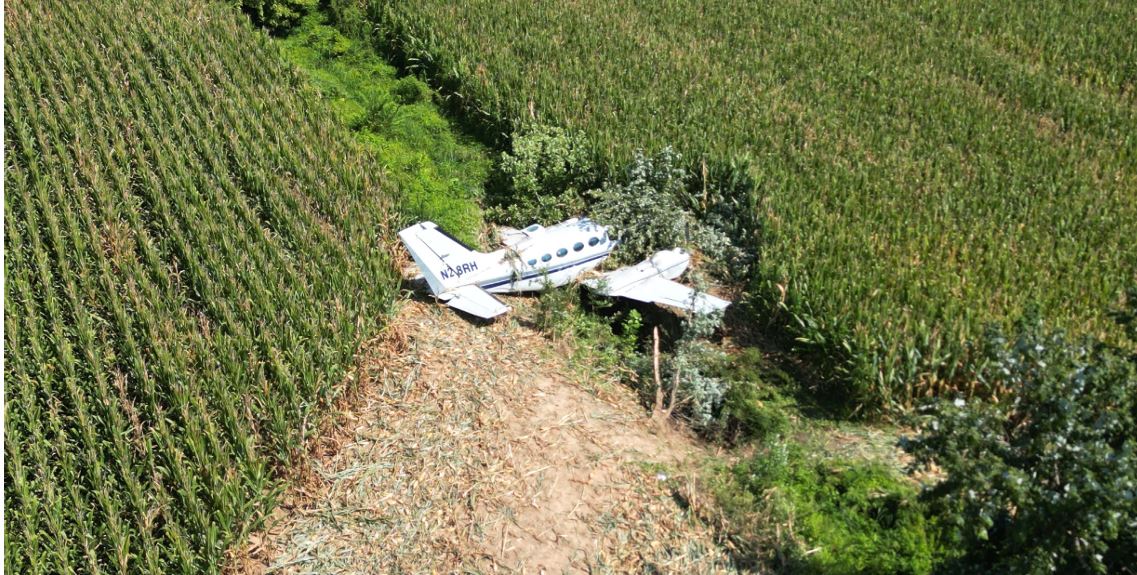

A Cessna 421 that went down in Kentucky in August was fueled with 145 gallons of Jet-A instead of avgas, according to the National Transportation Safety Board (NTSB)’s final report.
The Cessna 421C, registered as N28RH, departed Blytheville, Arkansas, on Aug. 21 on an IFR flight to Lima, Ohio. Shortly after takeoff, the No. 1 cylinder on the right engine began running hot. The pilot leveled at 5,000 feet, but the problem continued, and he shut down and feathered the right engine.
The remaining engine then began to deteriorate, and the airplane could no longer maintain altitude. The pilot attempted to reach an airport but made a forced landing in a cornfield about two miles away. The aircraft sustained substantial damage to the right engine mount, fuselage and empennage. Two people suffered serious injuries and two had minor injuries.
Investigators determined that the airplane had been topped off with Jet-A at the departure airport. The fueler told the NTSB he added about 70 gallons to the right wing and 75 gallons to the left.
The fueler said the pilot had only asked for the airplane to be topped off. He assumed the pilot wanted Jet-A because pilots seeking 100LL typically used a nearby self-service pump, according to the interview.
The pilot told investigators he did not specifically request 100LL. He also said he read the fuel receipt after fueling and saw that Jet-A had been supplied, but the group was in a hurry to get home. They departed without inspecting or sampling the fuel.
The NTSB determined the probable cause was the misfueling by the refueler, with the pilot’s failure to verify the airplane had been properly fueled before departure listed as a contributing factor.
The airport manager told investigators that the fueler was no longer working at the airport and that the airport had begun creating a form for pilots to specify the type and quantity of fuel they want.


Always,always,always directly monitor/supervise fueling at a FBO, especially in a turbocharged twin. Monitoring/supervising fueling was mandatory at the pt135 companies I flew for, even for a jet.
We unwittingly fueled our car with diesel one time. It would hardly run.
But the pilot’s decision to take off even though he knew his plane was filled with jet fuel is a stunningly bad choice.
Back before retirement flying and maintaining King Airs, I always monitored the refueling. Number one to prevent misfueling, and to make sure they didn’t destroy the anti siphon valve on the outboard outer wing fuel tanks, which are a real pain to change.
Nature has a way of sorting out bad genetics.
This accident, in part, can be traced back to the airport manager who failed to properly train and supervise line service. Not only is a C421 a piston twin that uses AvGas but the other tactile clues were plenty to prevent this avoidable accident.
Sure, the pilot could have supervised line service and specifically said AvGas, not Jet A, but it’s reasonable to expect line service is reasonably trained and aware of fuel requirements.