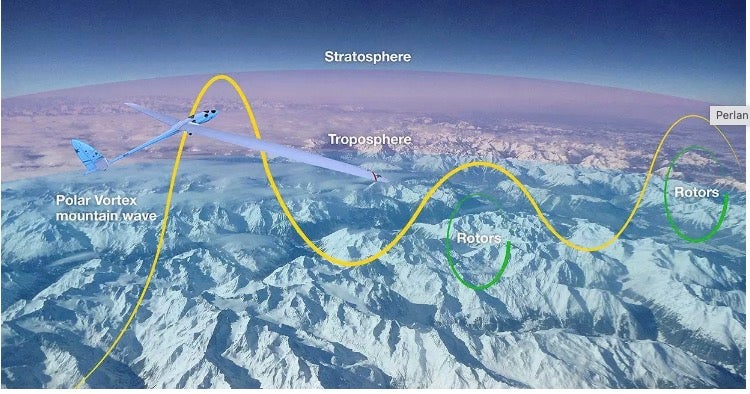

Though placed on hiatus during the COVID pandemic, the Airbus-sponsored Perlan Mission II will attempt later this year to set a world altitude record for manned, level flight—in an unpowered glider. The target is 90,000 feet, where, the project leadership says, the Earth’s atmosphere is more akin to that of Mars. Airbus contributed to the construction of the one-off, pressurized Perlan 2 that is “equipped with sophisticated life support systems and instrumentation to ensure pilot safety,” according to the program.
There is more at stake here than bragging rights for setting a record. According to Perlan Project CEO Ed Warnock, the flight will provide “unique opportunities for aerodynamic studies related to turbulence, extreme weather and future space exploration.” Furthermore, as a non-powered aircraft with no emissions whatsoever, the pressurized Perlan 2 “is ideally suited to the high-altitude atmospheric research the team will conduct to inform more accurate climate-change models.” Besides the data-collection equipment for that research role, the Perlan 2, which Warnock describes as “a space capsule with wings,” will also carry experiments developed by school-age students as part of a STEM (science, technology, engineering and math) cooperative effort with Teachers in Space.
The Perlan 2, which has already set the subsonic world altitude record at more than 76,000 feet in 2018, is currently en route by ship to El Calafate, Argentina, where terrain and stratospheric mountain wave conditions are ideal for the research flight and altitude-record attempt. Mountain wave currents in the region are strengthened by polar vortices. Conditions there are said to be optimal between July and September, when the test flights are scheduled.
C. Jeffrey Knittel, Airbus Americas chairman and CEO, said, “If a glider, which is a truly zero-emission aircraft, can become the highest-flying aircraft of all time, it sends a powerful message that decarbonization of aviation is no impediment to achievement, and can even be an enabler.”