
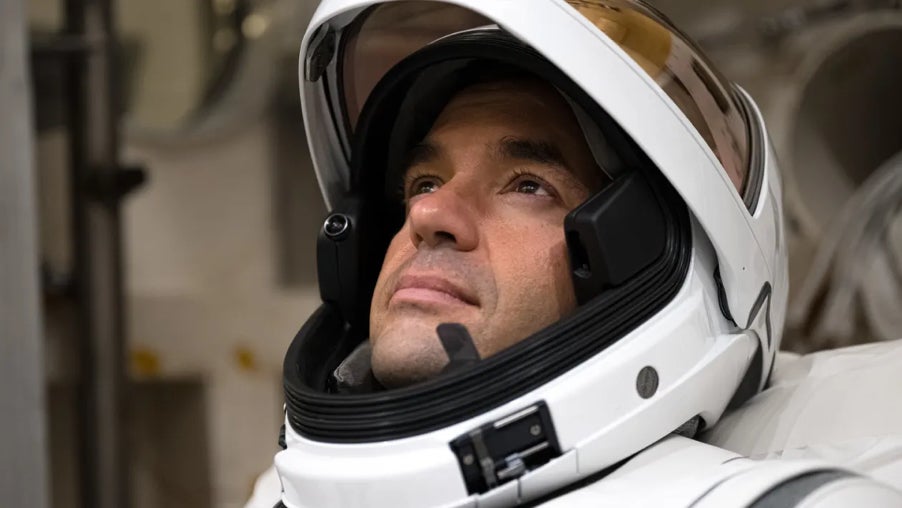

Technology entrepreneur and space/aviation enthusiast Jared Isaacman launched Tuesday (Sept. 10) on the SpaceX Polaris Dawn mission. Powered by a Falcon 9 rocket, Polaris Dawn is the first of three privately funded flights. Isaacman is joined by fellow crew members Scott “Kidd” Poteet, a close friend and retired USAF pilot, along with SpaceX engineers Sarah Gillis and Anna Menon.
Dubbed “Resilience,” the spacecraft has already bested the distance any human has traveled into space since the 1970s NASA Apollo program. The crew, protected from heightened radiation levels by their extravehicular-activity space suits, has already reached the Van Allen belt region.
Having already performed more than 40 scientific experiments after achieving the mission’s peak altitude of 1,400 kilometers (870 miles), the crew anticipates participating in the first privately sponsored extravehicular activity (EVA) excursion in history tomorrow (Sept. 12)–Day 3 of the mission. Because Resilience is not configured with an air lock, the entire cabin must be depressurized for the space walk. So all four crew members must secure their space suits even though only Isaacman and Gillis plan to exit the spacecraft.
The overarching goal of the Polaris Dawn mission is to further SpaceX’s broader ambition of promoting the interplanetary human experience. Gillis said, “So far only countries have been able to perform a spacewalk. SpaceX has huge ambitions to get to Mars and make life multi-planetary. In order to get there, we need to start somewhere.”
Update: Mission leader Jared Isaacman and SpaceX engineer Sarah Gillis successfully performed the first privately-funded spacewalk early this morning (September 12). At 435 miles above the Earth, they exited the spacecraft at 6:12 am EDT. Isaacman said while standing in the hatch of the SpaceX Crew Dragon capsule, “Back at home, we all have a lot of work to do, but from here, Earth sure looks like a perfect world.”

[Image: SpaceX]
Correction: A previous version of this story misstated the peak altitude of the mission.